Waterfront Wheat: The Short Life of Prescott’s First Grain Elevator
by: Craig I. Stevenson
Along the St. Lawrence River, the flows of time and change have been forces of creation and destruction, breathing life and character into communities and then departing abruptly, leaving little or no sign of a previous age. The scale of change can be hard to fathom. Photographs reveal a very different waterfront than the one we see, but the meaning of that change becomes lost in time.
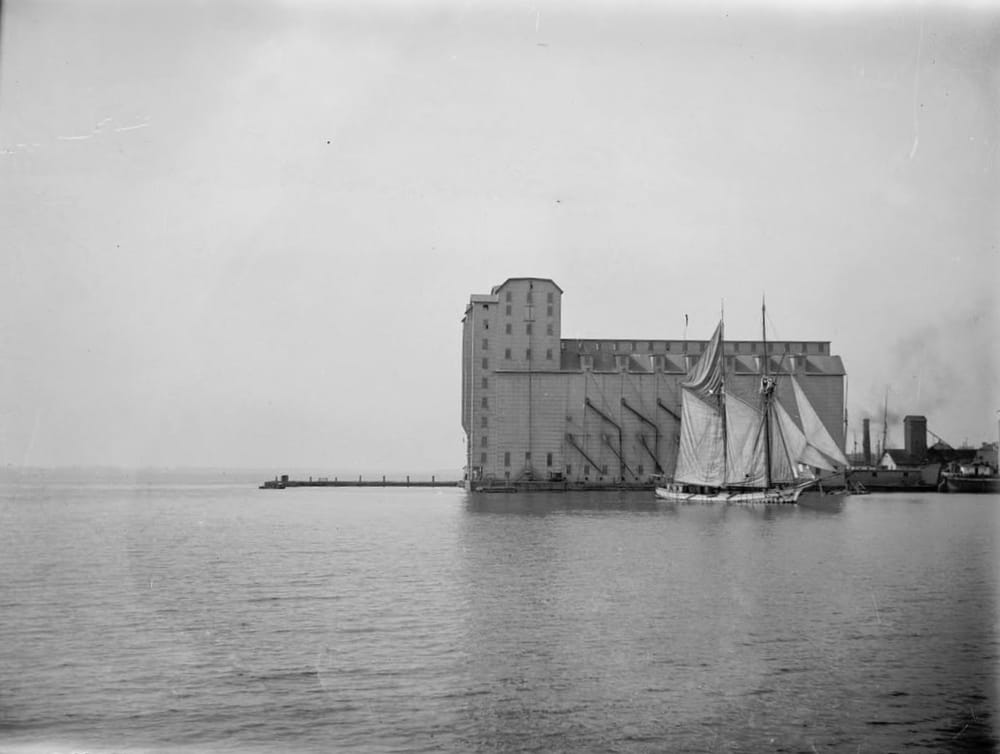
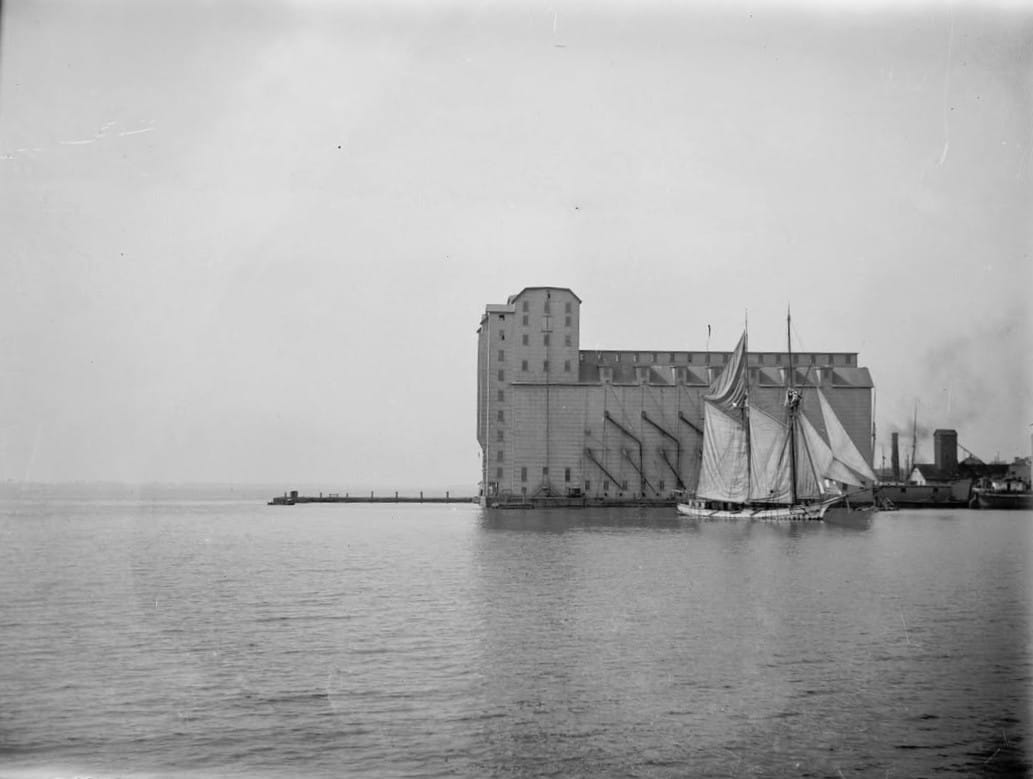
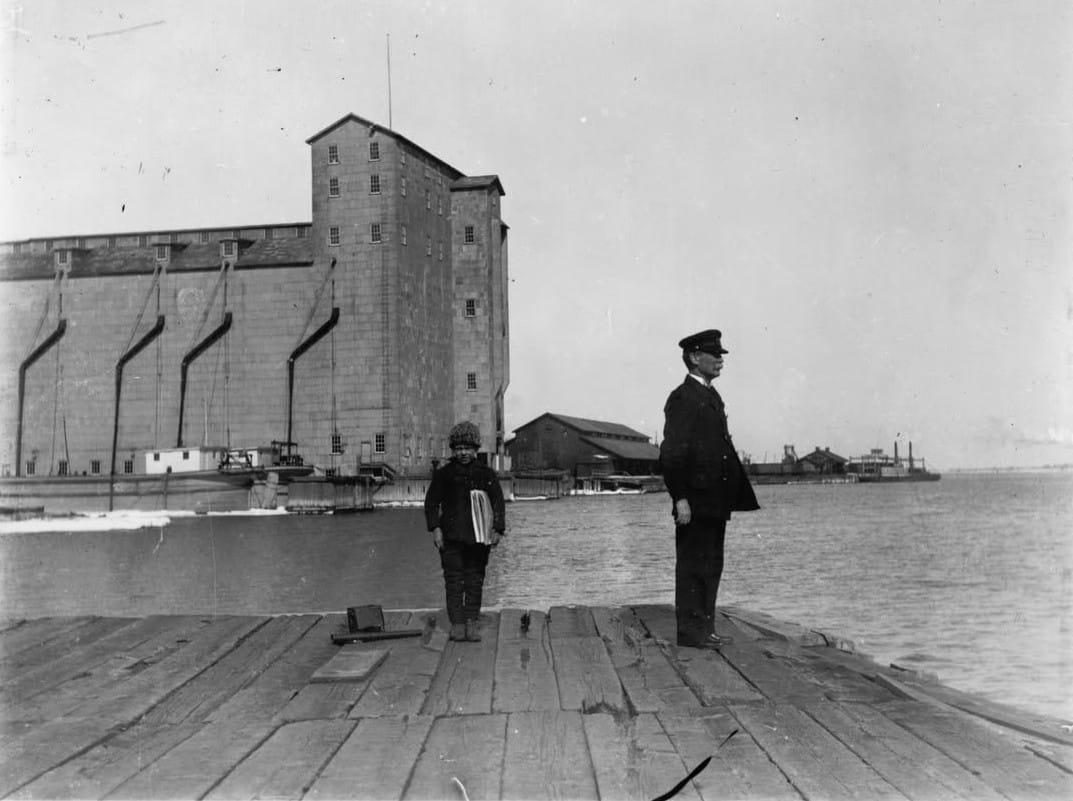
For three decades, a massive grain elevator loomed over the waterfront at Prescott, Ontario—and then was gone, swept away by evolving trade patterns in a country just starting to realize its economic potential.
The elevator’s origins trace to 1891 with a rumour and a public lament voiced through the community’s newspaper. That year, the Prescott Journal mentioned the possibility of a floating grain elevator being built on the waterfront by the Montreal Transportation Company to compete with the elevator across the River at Ogdensburg, NY. The volume of grain moving out of North America’s agricultural west was expanding rapidly, and Prescott could grab some of this downriver trade.
Soon after, a complaint: low-water conditions had left numerous grain-filled barges along the Prescott waterfront, unable to proceed further east through the canal system to Montreal. An elevator would have prevented this congestion. “Wake up gentlemen” intoned the Prescott Journal’s editor.
And some did.
In 1895, the Prescott Elevator Company started construction on a waterfront elevator. The PEC was a consortium of local and Ottawa investors, two of whom were engaged in industries directly related to the grain trade. Prescott’s J.P. Wiser was a distiller, and George Frederick Benson of Cardinal operated the Edwardsburg Starch Company.
With a twenty-year tax exemption and municipal grant money in hand, the PEC started construction in February 1895 as the first pilings were driven on the waterfront. Responsibility for the elevator’s design and construction fell to J.A. Jamieson, head of elevator construction for the Canadian Pacific Railway. The chosen location for the elevator was just west of the CPR waterfront yard to allow for three spur lines to run into the elevator. Two marine legs and a shovel system created an elevating and transfer capacity of 25,000 bushels per hour.
Construction finished in the autumn of 1895. The elevator took its first shipment on November 20th when the steamer Millbourne, captained by William Delaney of Prescott, delivered corn for Edwardsburg Starch.
Anticipating a brisk business, the PEC doubled the elevator’s capacity to one million bushels with an extension constructed from October 1896 through the spring of 1897. Through 1897-98, the company acquired a fleet of eight steel barges and a tug—the E.B. Eddy, purchased from its namesake Ottawa lumber firm.
The initial success of the PEC caused consternation upriver at Kingston. In July 1896, the British Whig reported that two-thirds of downbound grain had bypassed Kingston for Prescott, with the town’s merchants losing significant business as a result. This initiated a civic debate in Kingston about recapturing the export grain business. In the meantime, the British Whig noted the steady stream of vessels heading past and down for Prescott. Steamers and schooners alike had, by the end of July 1897, delivered 1.1 million bushels of Chicago corn to Prescott for furtherance down the canal system to Montreal. By May 1897 the weekly British Whig was describing the elevator as “blockaded” with grain beyond capacity, and that it could not acquire enough transport barges to move grain down the St. Lawrence canals and relieve the “congestion” at Prescott. The following year, instability in the American grain market linked to the Spanish-American War led to an overflow of export wheat arriving at Prescott, with the elevator handling two million bushels of grain by the end of May.
That state of prosperity would soon change for the Prescott operation. By the end of the century, Prescott faced competition from the elevator across the River at Ogdensburg, as well as Kingston’s newly constructed Mooers elevator and the expanded Richardson elevator.
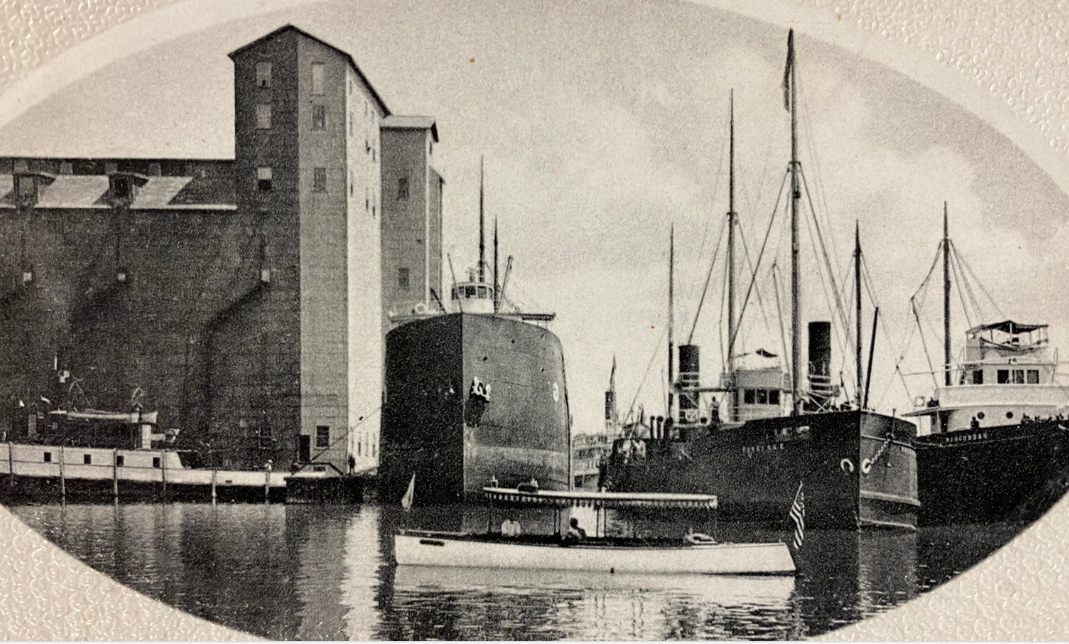
Another blow was received from the Canadian government. Increased grain output from western Canada started to exceed the capacity of the St. Lawrence canal system to move it downriver for export, and in 1899 the Dominion government acted to relieve the pressure by subsidizing railway grain transport. A considerable portion of the grain trade moved quickly to a shipping route from the head of Lake Superior at Port Arthur to elevators at Depot Harbour on Georgian Bay, and then on to Montreal over the Canada Atlantic Railway.
In 1901, the elevator was shut down. In 1902 the New York Times reported that the Prescott elevator, having “done very little business for two years,” had declared insolvency. The following month, the paper reported that the elevator had been sold under court order for $50,000, and its steam tug and eight steel barges were up for bids. This report was premature, however. The elevator was again put up for sale in 1903, sold to the Montreal Transportation Company for $28,000, and renamed the Prescott Terminal Company.
The new owners were able to breathe some life into the business. A report in The Ottawa Citizen in August 1905 carried the news that the elevator was being reopened to take advantage of an exceptional western grain harvest. It had been dormant for the past six years and was, in the words of the paper, a “white elephant.” In May 1906, the Prescott Journal noted that a pair of ships from Fort William—the Strathcona and the Algonquin—arrived at the elevator to deliver a combined 161,000 bushels of wheat. The volume of grain arriving from western Canada in the first decade of the 20th century created sufficient business to prompt a complete overhaul of the elevator in 1909 “in anticipation of one of the best seasons on record” according to nearby Kemptville’s Weekly Advance.
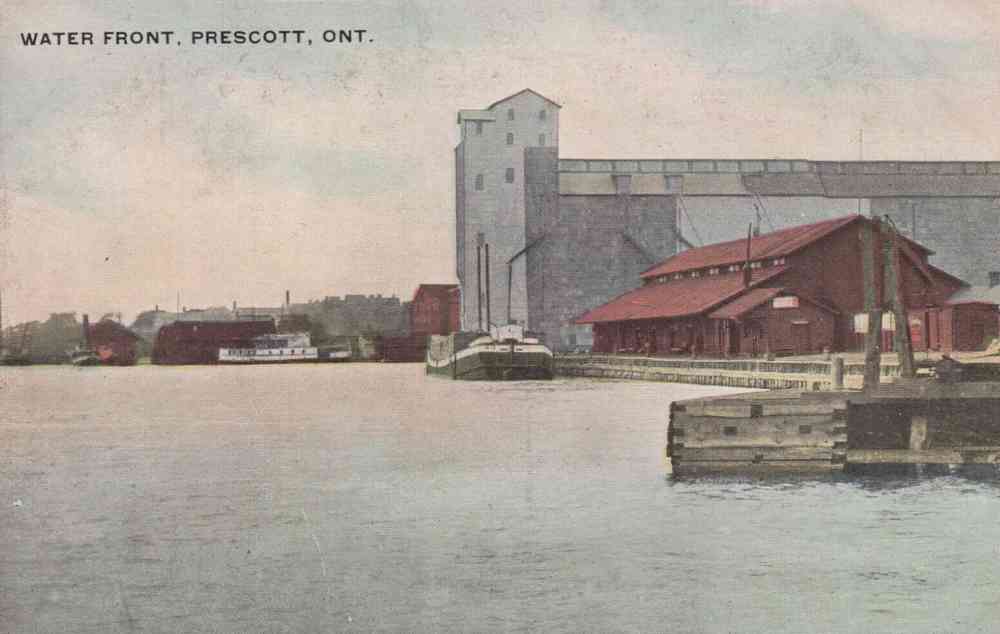
But the Prescott elevator would never recover from the establishment of the Lakehead-Georgian Bay route of combined water-and-rail grain shipping, once Alberta and Saskatchewan exports increased rapidly in the early years of the 20th century. Grain shipments from Port Arthur—Fort William dried up almost completely, and the elevator closed again in 1916. It languished on the waterfront and was the target of arson in 1917.
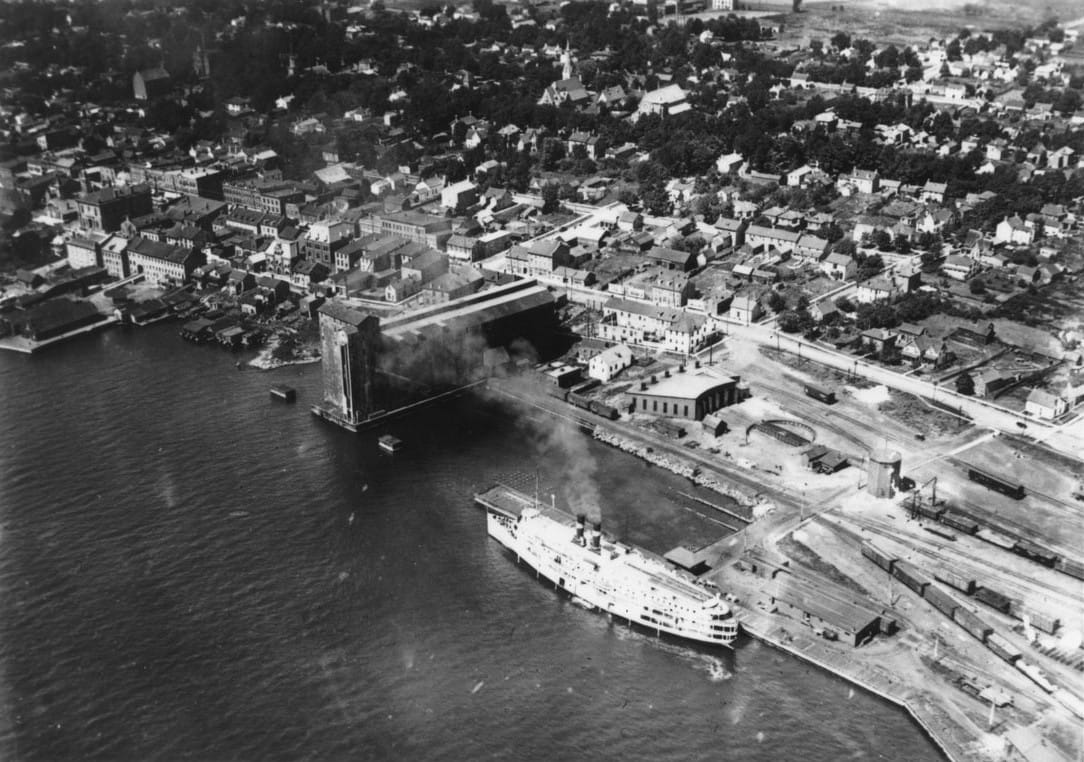
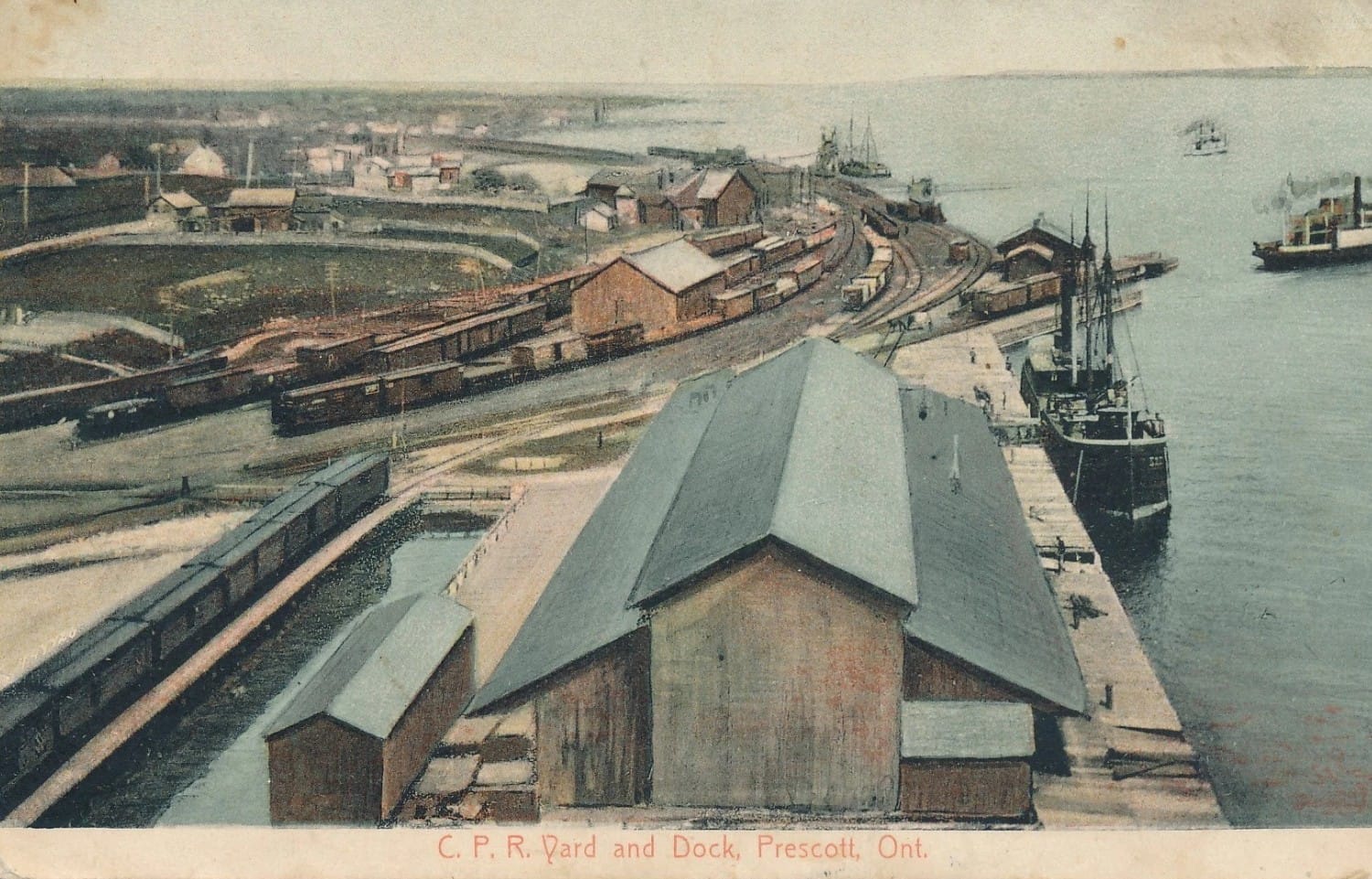
L: An aerial image of the Prescott waterfront, with the grain elevator at the center of the scene. Across the harbour, the SS Kingston is docked at the eastern terminus of the regular run from Toronto. [Grenville County Historical Society.]; R: Looking east from the elevator roof over Prescott's CPR yard and rail ferry terminal. The degree of industry along the Prescott waterfront in the early 20th century is almost unimaginable today. [Author's collection.]
In 1920, the Prescott Terminal Company was acquired by Canada Steamship Lines after it purchased the Montreal Transportation Company, but that change of ownership did not change the elevator’s business fortunes. In 1925, the elevator was demolished by the S. Anglin Company of Kingston and its salvaged wood sold to the public. By the following spring, a brief mention in Kingston’s The Daily Standard noted that nothing remained at the site except “the foundation upon which the monarch of bygone days rested and the space which was once a hive of industry . . . now as barren as the desert of Sahara.”
A cycle of industry on Prescott’s waterfront had ended, its fate sealed by shifting patterns in a nation still learning how to maximize transportation efficiency across vast distances. Grain returned to the area in 1931 with the opening of a larger, modernized elevator array a short distance east at Johnstown. What remained was the problem of a nineteenth-century canal system unable to handle the output of Canadian agriculture.
The elevator’s brief presence underlines the local impact of evolving trade patterns, the importance of the St. Lawrence River as a trade route, and why the need for the modern Seaway emerged well before its 1950s construction. As an anecdote of economic history, it is a reminder of how Canada developed trade and transportation networks that continue to uphold a significant degree of national prosperity.
There is no remaining evidence of the elevator on Prescott’s waterfront. Its location at the foot of East Street is now the Sandra S. Lawn Harbour & Marina and reflects a different relationship between the town and the St. Lawrence. Though absent visibly, it lives on in the historical fabric of a “Lost River” that remains connected to the present.
By Craig Stevenson
Craig Stevenson is a teacher at North Grenville District High School in Kemptville, Ontario. He is an avid historical researcher and writer of stories about the St. Lawrence River and rail history in eastern Ontario. Craig recently published his first book, "Was it Ever There At All?: The Brief and Transitory Life of a Railway Junction at Bedell, Ontario."