The Ogdensburg Trolley
by: Richard Palmer
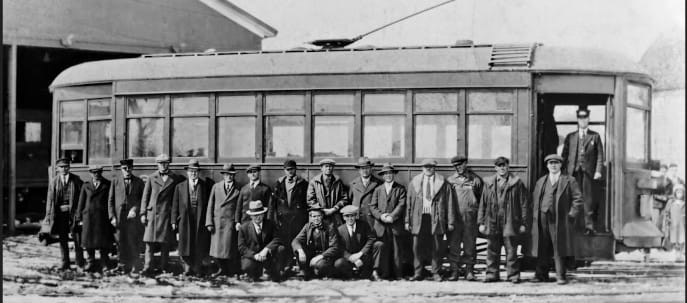
Like most cities throughout the Northeast, the street car systems evolved from diminutive 19th century horsecars, such as the one in Ogdensburg. When the trolley first started operating on August 14, 1886, it was very popular. It had a fleet of six cars and 12 horses, which were housed at a stable on Catherine Street. In 1895, when the trolley transitioned to electric service, the electricity for the trolleys came over a 38-mile transmission line from a generating plant at Hannawa Falls, owned by William B. Goswell of Syracuse.
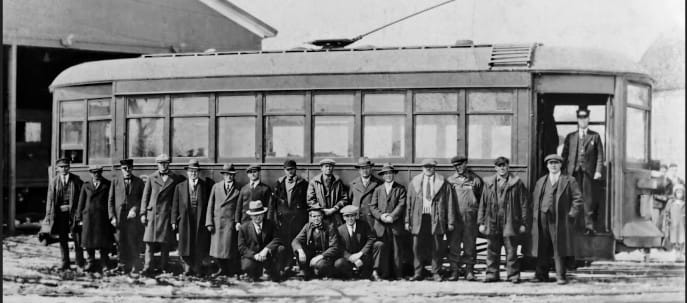
Initially, the cars ran at 15-minute intervals from 6 a.m. to 11 p.m. and the fare was five cents. But during winters that often left the city deeply buried in snow, operations did not always keep to published timetables. Large groups of men were employed along with sweepers to keep the lines clear. When the service first started, it sometimes carried more than 1,400 passengers daily. At first there were four box and six open cars, but additional cars were bought later, including five double truck cars. The car barn was on New York Avenue and the powerhouse was located at Lake and River Streets. It was once proposed to extend the line another 18 miles from Ogdensburg to Waddington.
When it commenced operations even the horsecars did well on its four and a half miles of track. This was the main line that ran from the railroad bridge to the end of New York Avenue, as well as a branch from Ford Street to the cemeteries. In those days, the cemeteries were a favorite destination.
There were also numerous branches of the line. Tracks covered New York Avenue, Main Street, Lake Street, Ford Street, and State Street, carrying residents and visitors to local events and summer destinations such as Sandy Beach. One did not have to travel far to have a good time.
Rolling stock consisted of five box cars, and some open bench cars, as well as "three box sleighs," which could operate independently of the rails during heavy snowfalls in the winter. When the system was electrified, the track was relaid with 48 and 52 pound (per yard) rail. On September 1, 1895 electrically operated trolleys commenced running. At that time, there were 10 miles of track.
The most important route, and the one retained the longest, was the Ford Street line from New York Avenue to the State Hospital, known in later years as the "Hospital line." The Main and State Street line (or "Main St. line") ran from Ford and State Streets, past the fairgrounds to the cemeteries. Needless to say, there was a spur to the Fairgrounds, an important source of traffic. In winter, the cars ran beyond the United Helpers' Home only on Sundays.
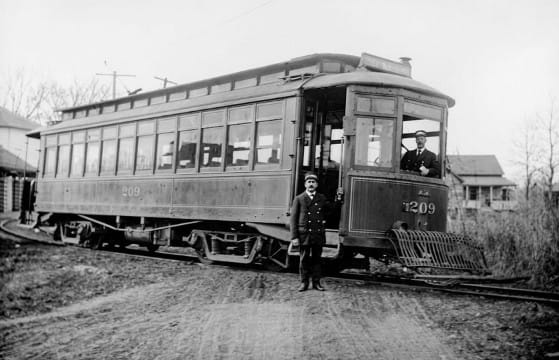
The King street line extended from New York Avenue to the match factory at the city limits, while the Patterson Street line (later known as the "Rutland Depot") ran from Ford and Patterson Streets to the Ogdensburg and Lake Champlain Railroad depot. For a time, the trolleys were a social and economic necessity.
On a single day—July 2, 1907—over 20,000 passengers rode the system without a single recorded accident. Sleighs were used in the winter during the era when horsecars were still used. Each of the sleighs was enclosed, had a liberal supply of straw placed in the bottom, and was equipped with a stove for the comfort of the passengers.
Key routes and destinations were:
· Ford & State Street Core: Served as the downtown hub where lines converged and passenger service commenced;
· State Street Line: Ran past the Sperling Building, down toward community parades, the fairgrounds, and regional cemeteries;
· Lake Street / River Crossings: Trolleys traversed key local spans such as the Lake Street Bridge;
· Sandy Beach: A primarily warm-weather destination where the trolley hauled crowds out for nightly dancing, live concerts, and sporting events; and
· State Hospital Line: Connected downtown workers and visitors directly to the sprawling Ogdensburg State Hospital grounds.
On the east side of the bay, the Rome Watertown and Ogdensburg railroad depot was filled with hustle and bustle. This was on the "Depot line," which ran to King Street and New York Avenue, later known as the "New York Central Depot line." The changes in the names of these two last lines occurred because the railroads whose depots they served themselves had changed names from the R.W. & O. to the Rutland when they became part of larger railroad systems.
The three shortest branches were abandoned around 1916, leaving only the Hospital line and the State Street branch. As automobiles became more common, the company struggled to survive in the small city. By 1932, thanks to both automobiles and buses, ridership had dwindled. The State Street branch was abandoned in 1928. The main line to the State Hospital survived until April 1, 1932. John H. Fox of 426 Lincoln Avenue, Ogdensburg was the motorman on the line. It was claimed by trolley officials that one car bound for the State hospital had recently carried only two passengers at a revenue of 14 cents, while the actual cost of operating a trolley car the same distance was $3.20.
By Richard Palmer
Richard Palmer is a retired newspaper editor and reporter, and he was well known for his weekly historical columns for the Oswego Palladium-Times, called "On the Waterfront." His first article for TI Life was written in January 2015, and since then, he has shared dozens and dozens of articles and more. He is a voracious researcher, and TI Life readers certainly benefit from his interests and we hope he will continue to share these important pieces of local history.