Maybe Katydid . . . But Maybe She Didn’t
by: Paul Hetzler
Even though I live in the country, during the latter part of the summer when it’s cool enough to sleep with the windows open, I can hear the neighbours arguing as I go to bed. Their back-and-forth bickering is full of baseless accusations – a real “he said, she said” kind of thing. It doesn’t keep me awake, but I wish they’d resolve their conflict. I want to know if Katy is guilty or not, and what it is that she supposedly did.
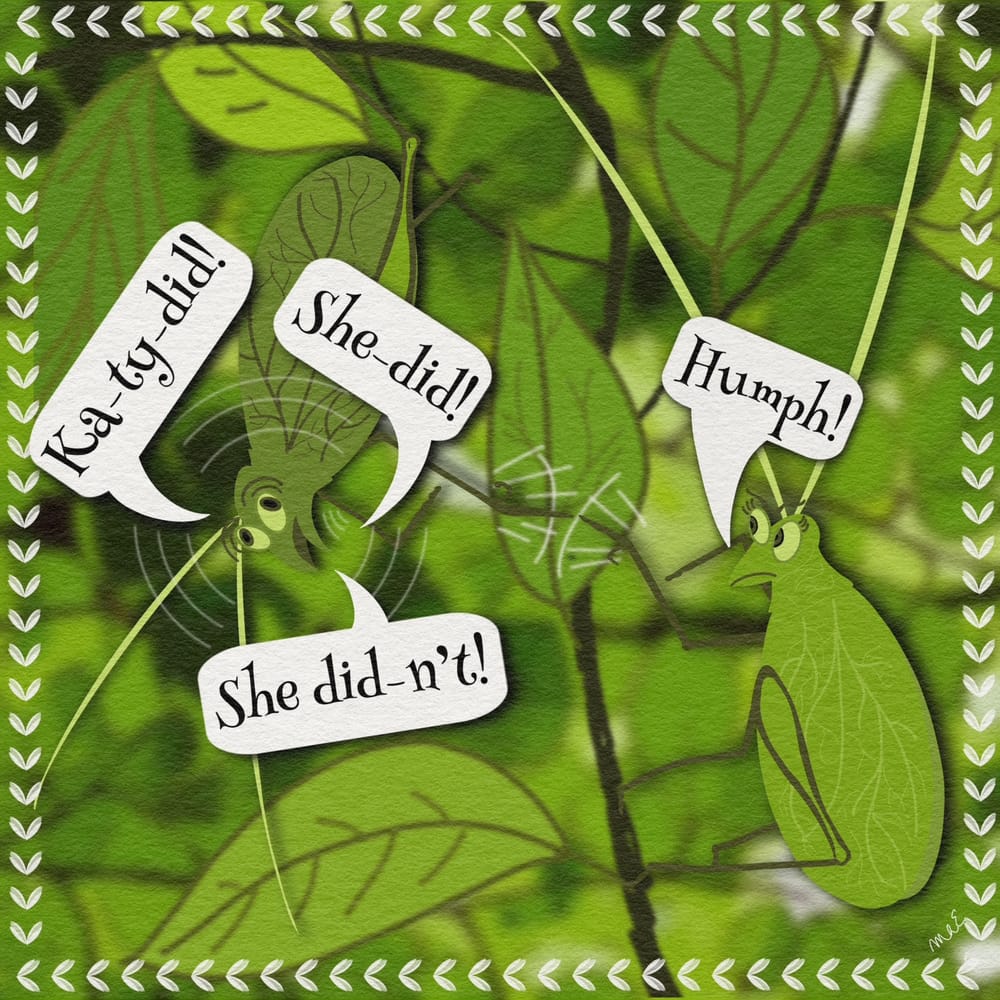
If you’ve never seen a katydid, that’s not surprising, as they are active mainly at night. But you might have heard them, especially if you neighbourhood is planted with a few trees, where they like to hang out. Though their calls can vary by region, katydids typically make an eight-pulse call, broken into three phrases. To many people it sounds like “Ka-ty-did, she did-n’t, she-did.” I suppose it’s more a case of arguing with themselves (shades of Gollum in that respect), but when one individual makes this accusation, another will echo it from a distance away, so it sounds much like like a conversation.
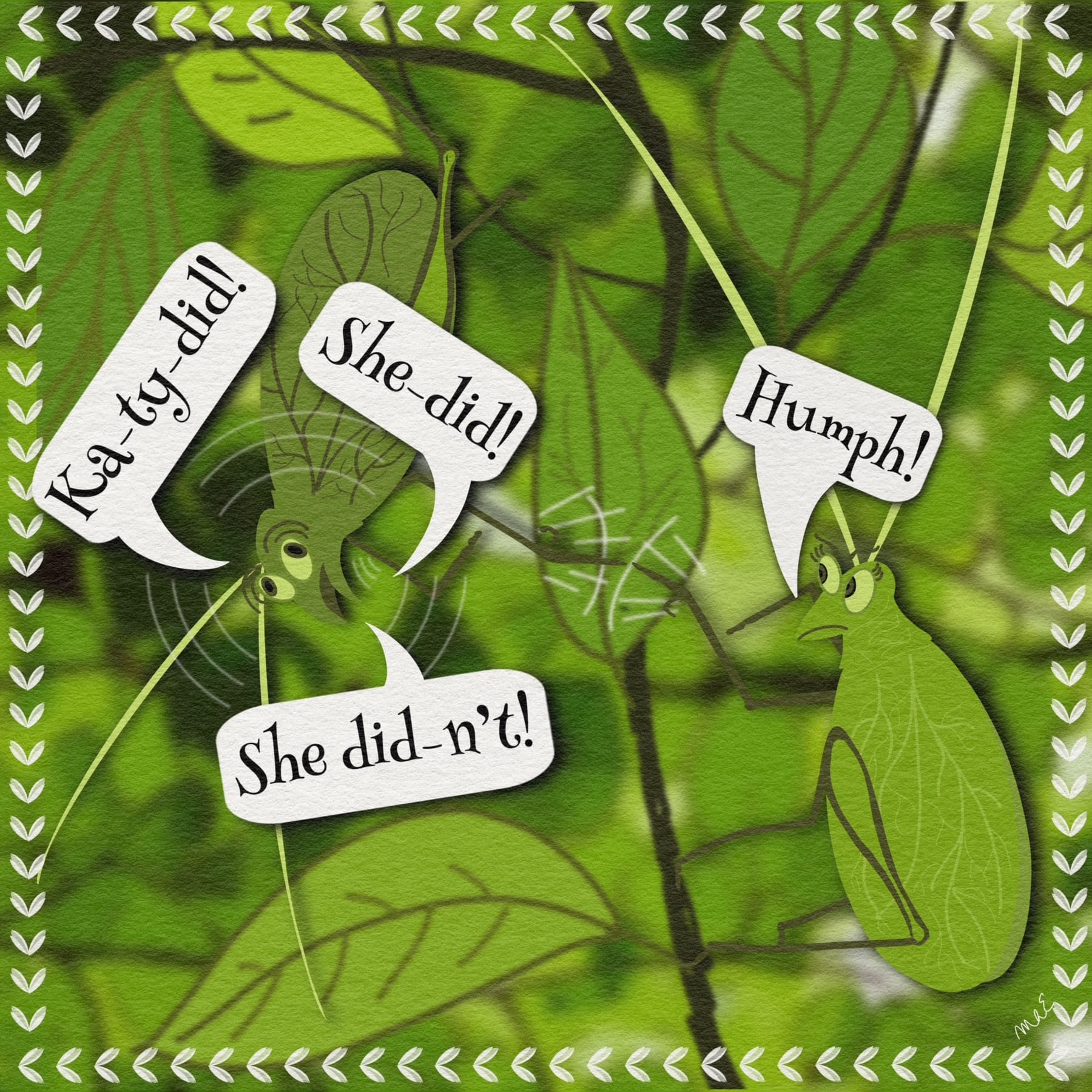
In most insect species, the males are the ones that make noise or otherwise put on a show to attract mates, and indeed it’s Mr. Katydid that does the Katy-did, no-she-didn’t routine. What’s unusual is that Ms. Katydid also calls, though her response is a one-note tick, which probably translates to “Humph,” as I’m sure she gets exasperated by her suitor’s circular arguments.
Katydids are native to just about everywhere on the planet but Antarctica – more than 6,000 species in all – with the greatest diversity found in tropical rain forests. North America is home to over 200 species. The southeastern US has more katydid species than other parts of the continent, but there are plenty of bugs to go around. Even though many species live in trees, some have even adapted to hot, arid conditions.
Similar in size and shape to their cousins the grasshoppers, katydids stand out mainly because of their long, wispy antennae and their typically bright green colour. If you’ve ever picked up grasshoppers as a kid, you know they’re as tough as they look. These feisty, well-built critters will spit goo on you and are apt to bite you as well. But the katydids I’ve seen look more frail, with their gossamer antennae, and the translucent bodies of the juvenile stages.
Speaking of breakable, I just learned about the lichen katydid, a bizarrely delicate, see-through insect from northwestern South America. It is so improbably fragile that it has been described as having been crocheted. Most katydids are green to blend in with tree leaves or other vegetation. These katydids went a step further to mimic lichens, which are a symbiotic amalgam of part fungi and part algae that “took a likin’” to each other. They grow on trees, but do not harm them, as lichens get all their food from the sun. In short videos of lichen katydids, they blend in so well with actual lichens that you probably won’t see them until they move.
I didn’t realize how many katydids live in trees until I stayed a few weeks in a house built into a steep hillside. The screens in the third-story front bedrooms, which were essentially in the treetops, were swarmed by these green insects on summer nights. Although they feed on many types of plants, including trees, katydids in most areas are not considered pests. One exception is the Mormon cricket, a type of katydid that can devastate crops out West in British Columbia, Alberta, Saskatchewan, and Manitoba when their populations surge upward. Katydids play an important role in the food web, and are a key source of protein for many birds and other small animals.
Not all insects make “music” the same way. Cicadas, among the noisiest out there, use a Rube Goldberg-like scheme that’s almost too complicated to believe. Katydids went for a simpler plan. Like crickets, they rub their front pair of wings, or forewings, together (they have two sets of wings), known as stridulation. to create their quarrelsome calls. Unlike crickets, whose calls serve as a pretty accurate thermometer, katydids can’t tell you the temperature.
But they might predict frost. An old Abenaki friend told me that katydids begin calling about six weeks before the first frost; this way one can tell whether or not it will be a late fall. I don’t know if such lore originated with First Nations peoples (which seems likely), but it has become a widespread belief. For a while I used to mark on the calendar when the first katydid called, and in my scientifically-unsound sample, the katydids were correct (i.e., Katy did) within a few days.
Recently I came across a story attributed to the Cherokee in which a hunter mocked a katydid for its short lifespan, and the katydid replied by predicting the hunter’s death that night, which came to pass. It’s not clear if the katydid caused his death or merely foretold it, but I’m not taking any chances. You’ll never catch me mocking a katydid. Being sixty-something is enough to make me aware of mortality. I hope to enjoy katydid song for many summers to come, but in the event I’m faced with a life-threatening health crisis, I won’t accuse them of having a hand in it.
By Paul Hetzler
Paul Hetzler is a former Horticulture and Natural Resources Educator at Cornell Cooperative Extension, in Canton, NY. He is the author of the website “Where the Wild Words Are" and writes articles about nature, which have appeared in several nature magazines, as well as The Saturday Evening Post and the Adirondack Almanack.
As well as nature essays, Paul writes books – check them out on these sites: https://www.amazon.com/dp/B0CCZSY8N9 (US) and https://www.amazon.ca/Birds-Happiness-Arent-Blue-educational/dp/B0CCZSY8N9 (Canada). The titles alone will make you smile – Head of the Class: Smart as a Slime Mold; Shady Characters: Leprechaun Trees, Plant Vampires and Caterpillar Soup; and his third book, Birds of Happiness Aren’t Blue: and 85 other very funny and yes, educational essays.