This Old House
by: Susan Ris Schongalla
A little boy stands stubbornly and purposefully on the front steps of my porch. His arms are wrapped tightly around the center post. He is resolute, he is serious; he will not let go.
His grandfather is just as serious, saying ”C’mon now, time to go.”
His grandmother comes out to create a committee of two saying, to get results the grandfather could not, “You’ll be back next year; it’ll be here before you know it!”
Well, as ALL children know, saying something will happen next year is not an acceptable way of expressing any logical thought. There is nothing even remotely interesting to a young person about “next year.” Waiting for next year to happen is so far off the calendar for this young child, one might as well have said “when you are a grandfather . . .”
I witness this vignette as if it happened yesterday, instead of close to 80 years ago. The columns, when I pass by on our old porch, are like beacons shining backward through our house’s history. How many people over the years have looked wistfully at them as they closed up in the fall?
I had the wonderful privilege of being able to visit with that very same person who told me that his summers here in Thousand Island Park were wonderful. He was always sad, angry even, that he had to leave. He did indeed have his arms wrapped around the column and my mind goes to that image now, thinking of my own departures from beloved places. In my case however, tears were usually involved. I was given a moment to wallow in self pity, but tears made no difference whatsoever and the departures were delayed only slightly.
This, of course, justified my feelings for being a perfect crank on the drive home. As a youngster, I gave no thought to the history of the old beach house we rented; only that I wanted the room that I thought of as “my” bedroom so I could look out the window to see who was coming down the sandy road to the beach. Some of the kids who were my friends came from houses that had been in their families for generations and perhaps generations of other families before theirs. But I gave little thought to who came to our house before we did. It was the “now” that was important.
Someone who occupied or built it, perhaps one hundred years earlier, had his or her own “now.” Did anyone ponder who thought to put some sticks in the ground and establish a relationship with the surroundings? To press the point further, were there people who occupied a dwelling of some sort on the place where our house, and others on the Wellesley Island promontory, sit? As for that summer house of my youth, I never asked my parents if they knew its history and now I am left to wonder.
Our non-summer house in New England was built before Lincoln (we were told that the nails in the floorboards were the identifiers). That old house certainly saw some history with its wonderful western view over the fields across the road. To this day I am more fond of sunsets than I am of sunrises. From our TI Park house we can see the sunsets and they always gladden my heart. Did the builder choose this lot so the sunsets could be seen? How many, and who, enjoyed their evenings sitting where I now sit looking out at the setting sun?
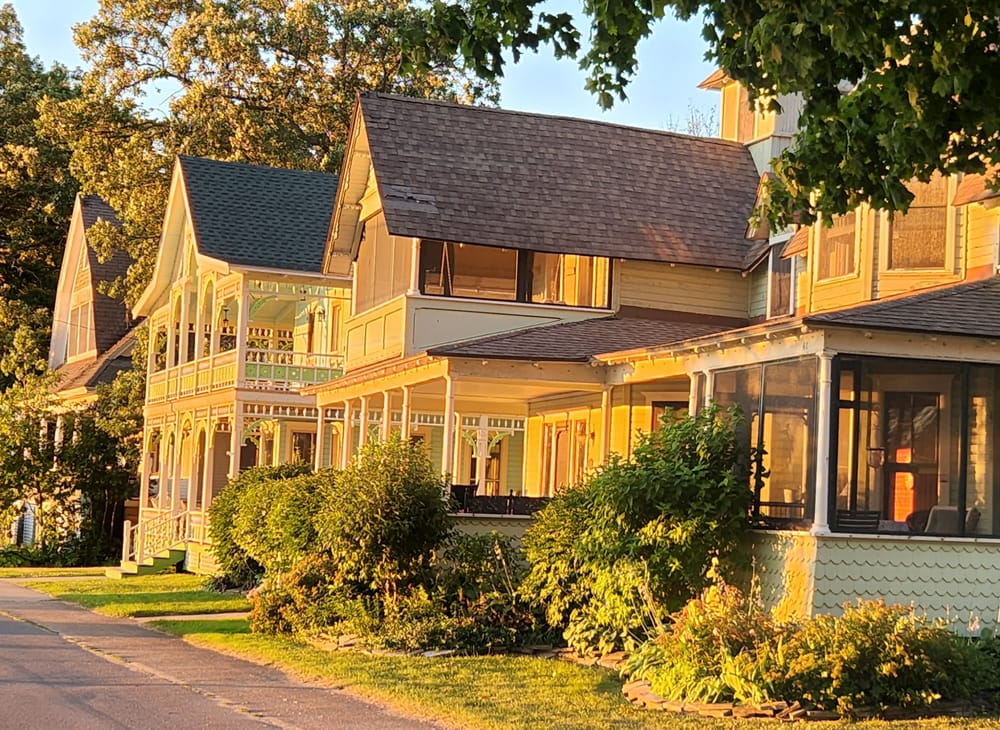
I have transferred my love for old houses from the ones of my childhood to the one of my “now” house. We are only the fourth owners so we have some basic knowledge of its past and who built it. But, what kind of life did these old houses give to their first owners? Did they satisfy the builders’ desire to be on the St. Lawrence River? Did it cause them to love life there? Did they take good care of it and what did they do? I am taking great pains to be “politically correct” by using “they.” In those years, it could have been a determined woman! If so, who was she and what kind of life was she living as she was directed to a colony in the Thousand Islands?
When one lives in an old house, it is great fun to be able to have a visit from a prior owner so as to hear new stuff about the old place. In our living room there is a huge hole in the lovely bead board about shoulder high. One wonders “Huh. Why?” Why would this happen to such a lovely wall? It seems there was a hifi (not a typo!) speaker installed there which explains the miscellaneous wires and gadget things on the other side of the wall in the closet. The same little boy grew to be a teenager and as such, thought this to be a good idea. The gadgets are still there but a framed poster covers the hole on the other side.
There are two very funny electrical looking knobs on the wall of a bedroom now covered by the head of an antlered deer. (Who put that there?) One wonders if it is safe to do anything about those knobs. Are they live? It is interesting that a door is now standing where a window once stood, a bathroom where once existed a back stoop. Our house now has a lovely kitchen. Once that space, smaller then, was attached to the back of the house under a shed roof. I don’t know why it is nice to know these things, but it just is.
Little bits of information, when added up, make us realize that these houses have lived long and interesting lives and in turn, as we go about our lives, give us comfort and good memories. It serves our emotions well to become aware that a certain history has gone before. If the chronology of the house is considered, a person can insert himself in its recent history.
For my family and me, it is becoming our history and my personal crystal ball. I hope that our boys, who will inherit it, will pass on information to owners who come after them. We will join the ranks of the thousands who have lived good lives in our cottages here in the Park. Thank you Deane Parkhurst, for making me more aware of this truth. I know the name Parkhurst because it is engraved into the lid of the trunk that sits at the foot of the bed in our guest room. That trunk is not the Parkhurst’s, nor is it ours. It belongs to the house and to its history. However, even if hugely compelling, there will be no other large holes in walls. Afterall, thanks to today's technology, speakers these days are tiny.
By Susan Ris Schongalla
Susan Ris Schongalla is a resident of Thousand Island Park. She has written what she calls, "every day" articles for the “Thousand Islands Sun,” and she and her husband Doug, often travel the world over when they leave the Park in the late Fall. You can see Susan's past TI Life articles here and here..