Half Moon Bay, the Start
by: Karen Wand
People have long been drawn to the spiritual atmosphere of Half Moon Bay. Each visitor to this sacred place is often awed by its stillness and solemn, peaceful dignity. Half Moon Bay is surely one of nature's sanctuaries.
Much of what I’m sharing with you today comes from old newspaper articles, and I think using the same language as it was written then is effective and moving.
Half Moon Bay is at the southeast end of Bostwick Island, in the Admiralty Group, about three kilometres southwest of Gananoque.
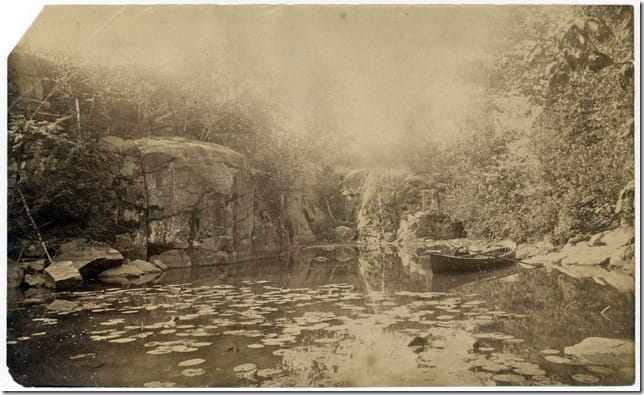
Half Moon Bay, also known as Lonely and Goblin Bay, is the most romantic place in our group of islands. The “old-timers” of the Thousand Islands seem to know of every phenomenon in the region. In many cases, they can explain the reason for some peculiar shoal, island, growth or freak formation, but none can explain the mystery of Half Moon Bay.
It was a great dyke of dolomite that was weathered out, leaving granite walls standing abruptly on either side. Afterwards, in glacial times, a torrent poured down beside the glacier through a crevasse, digging successive great potholes and one or two tiny ones, a foot or two wide and deep.
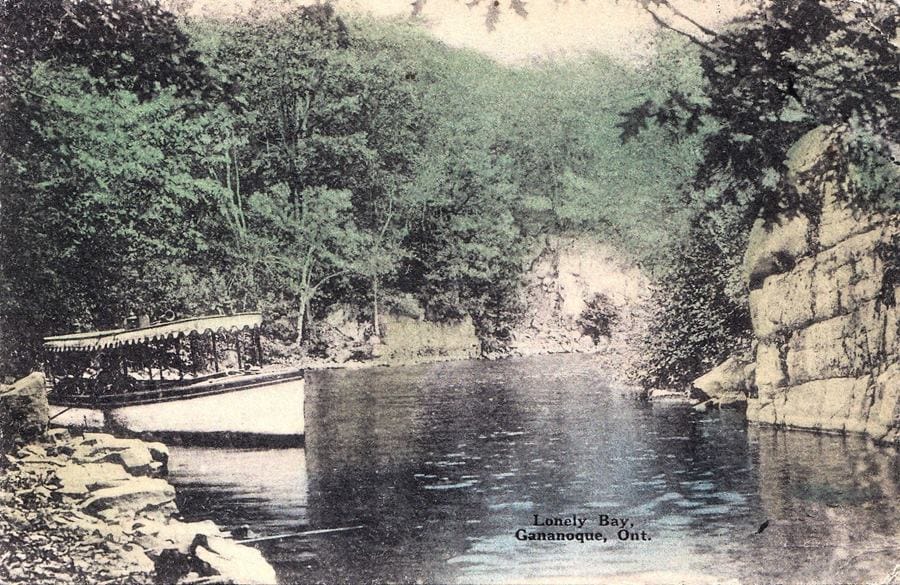
In the 1880s, Lonely Bay was a wilderness. Decayed logs, stones, and debris of all kinds choked the inner part, making navigation impossible beyond the central bend. By land, the entrance was equally obstructed by thick underbrush, loose stones, and a tangle of wild growth.
In the 1940s, the Secretary-Treasurer of the Board of Directors, Clifford Sine, recalled that three families were represented at these first occasions: Samuel Finley, Rev. James Allen, and Arthur P. Coleman. They sent out invitations to attend a “snag party” to be held early in the morning in the vicinity of the Bay. In freshwater ecology, the term snag refers to trees, branches, and other pieces of naturally occurring wood found sunken in rivers and streams.
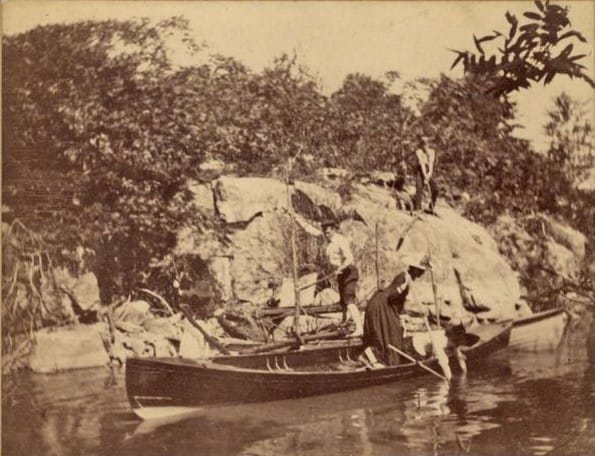
In June of 1887, they met for breakfast, and it was described as hilarious. After breakfast, the men put on their swimsuits and began clearing out the inner recesses of the Bay. It was described as a valiant exercise of heaving out the clogging mud, stones, water-logged trees, etc, surrounded by the sounds of laughter, of shouted contradictory advice, of splashing and scraping. With much shuffling and confusion, three boats gradually get into line for a pull. One! Two! Three! And away! Splash and spatter and splurge, and three boats pull frantically at three different moments, but the snag rests peacefully where it was! The work went on, and their efforts were successful. The rowers wipe their perspiring brows, and those who only gave advice congratulate themselves on the braveness of the exploit.
Before the first preaching service, summer residents gathered on Sunday afternoons for meditation, prayer, and hymns. Until the “snag party,” they would meet at the entrance to the bay, unable to proceed any further.
On July 9, 1887, Rev. John H. Castle, president of McMaster University, travelled among the islands in search of a suitable one to purchase. Rev. Castle began the habit of going on Sunday evenings with a few other islanders to Half Moon Bay for an informal service of hymns and prayer. That year, he delivered an eloquent discourse, revealing his kinship with the occasion and surroundings. As the community grew, they held nondenominational services, chiefly under the leadership of Dr. Castle. On fine Sunday evenings, 200 or more boats of all kinds and sizes might be seen threading their way among the numerous islands, hastening to join the open-air worshippers.
A Boston man named David Wallace purchased the property around the bay in 1901; his brother and nieces were the first summer residents of the Admiralty Group. Deeply impressed by the beauty and significance of the bay's services, he presented the land to the island community to continue and maintain as a place of worship.
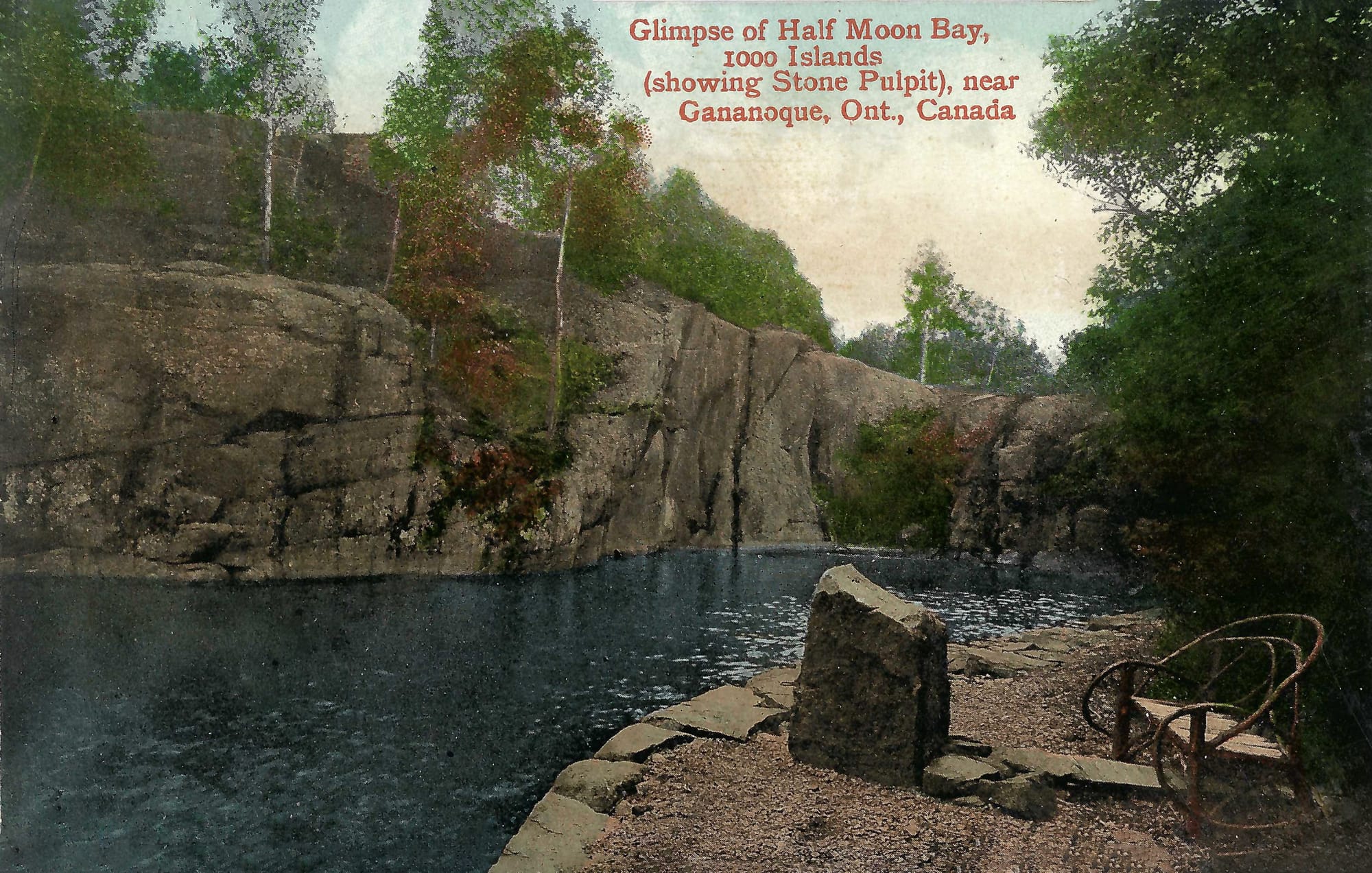
Provided by David Wallace, a natural granite pulpit was found nearby and brought into use, revealing the handiwork of nature.
The shoreline was defined and made safer for skiffs and canoes, and landing places were adjusted. By creating a tree-shaded path, the land approach to the bay became more beautiful. Originally, hymns were accompanied by a guitar, and later by a violin. Eventually, a portable organ was brought in to aid the singing, and many vocalists contributed.
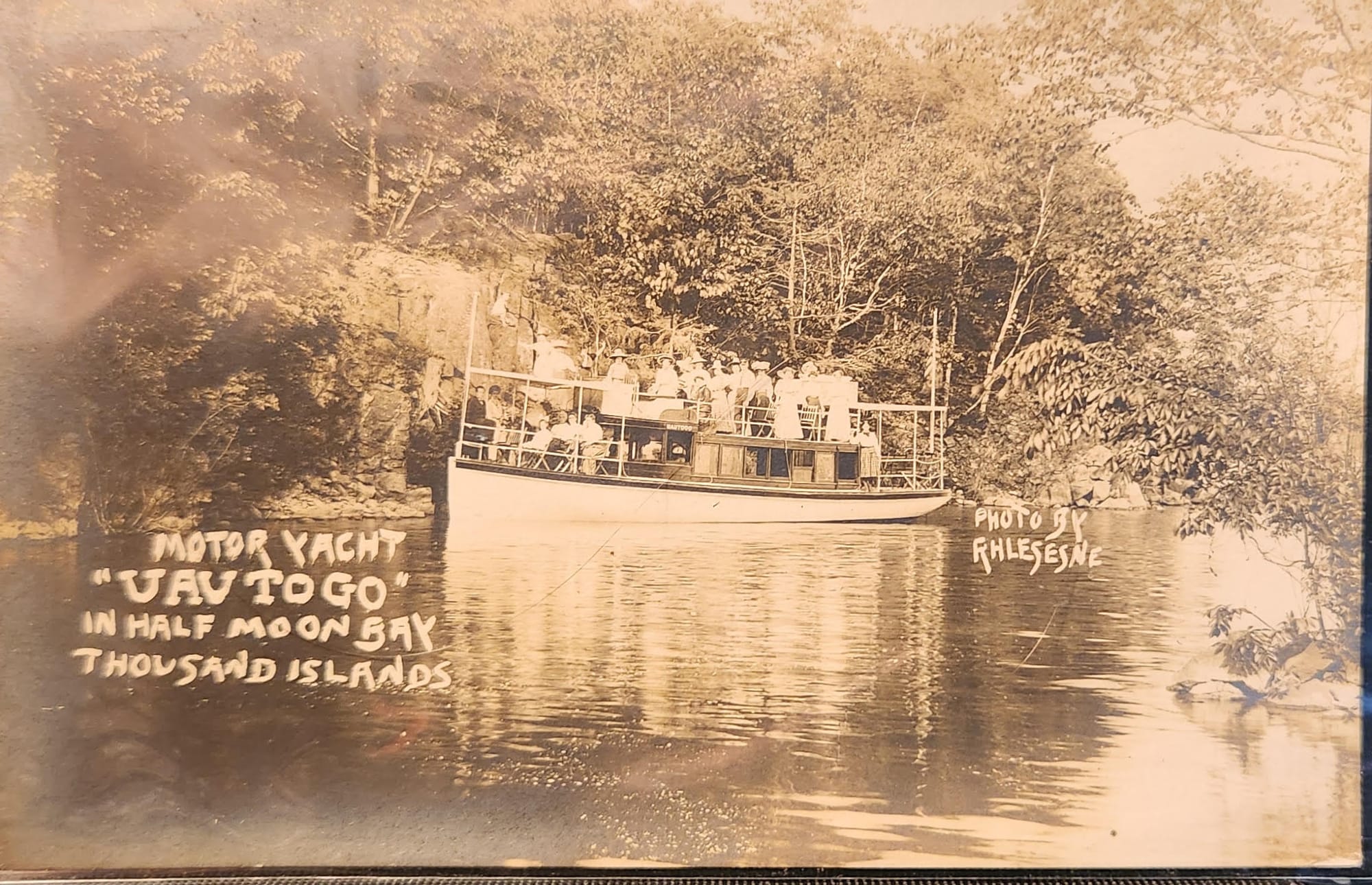
Boats of all descriptions would travel from distant ports on both sides of the border, such as Thousand Island Park and Alexandria Bay, for the evening services. The Glorie II, out of Clayton, N.Y., advertised Half Moon Bay ferry service at the price of 25 cents.
A large number of island residents and town citizens wrote to David Wallace on July 1, 1903, about their inexpressible satisfaction and pleasure to hear that he had purchased this beautiful property and proposed to dedicate it for all time to the service of God. “Many of our happiest and tenderest memories of the Islands cling around this spot.” It was signed by people from New York State, England, New Jersey, Maryland, Montreal, Sault Ste. Marie, Vermont, and Kingston. When David Wallace died in 1904, he bequeathed the property and Bay to the Town of Gananoque to be held in trust as a place of worship. By the generous cooperation of the Gananoque clergy, Sunday afternoon services have been held and largely attended over all these years.
Accidents will happen without regard for persons or ceremonies, and in August 1916, the service was well underway and everyone’s heads were bowed, when a loud splash was heard. When the congregation looked up, the minister was missing from his accustomed place behind the pulpit. An immediate investigation followed; of course, the dripping wet clergyman was pulled from the water and taken to “a place in the sun.”
In 1937, a bronze plaque was mounted on a granite pulpit to commemorate the Golden Jubilee. The names listed on the plaque are David Wallace, Rev. Charles E. Kidd, Clifford Sine, the Rev. James Allen family, the Arthur Castle family, the Edwin Dickson family, and the Samuel Finley family. A. Vibert Douglas recalled that the early worshippers also included the Hall, Wallace, A.P. Coleman, and Douglas families. Susan Smith would like to give a big shoutout to Don and Anne Byers’ family and to former TI residents Jane and Rob Hanson. They had stepped in many years ago and designed the service to welcome children, visitors, and traditional worshipers.
Howard Gowing served as secretary and treasurer of the funds. It was his responsibility to collect the money and pay the speakers. Howard worked diligently with Grandy Hoyt during the 1950s and ‘60s to revitalise the Bay. The PA system and organ were installed after Hydro ran lines to the site under the direction of these two gentlemen. They improved the pulpit and deepened the water by dredging.
The program was augmented by inviting ministers from across the United States and Canada. One of those invitations was extended to Dr Martin Luther King Jr., dated February 26, 1964. Dr Robert McClure, a former moderator of the United Church of Canada, accepted his invitation and spoke at Half Moon Bay in July 1975.
Boy Scouts from Gananoque were supplied with canoes, and they paddled around, passing out hymnals and an envelope for the offering, juggling both desperately to avoid spilling them. On bad days, a few dollar bills had to be fished out of the water, and an unsubstantiated story goes that a hungry pike once snatched a Canadian $2 bill before the churchgoer could get it into the collection basket.
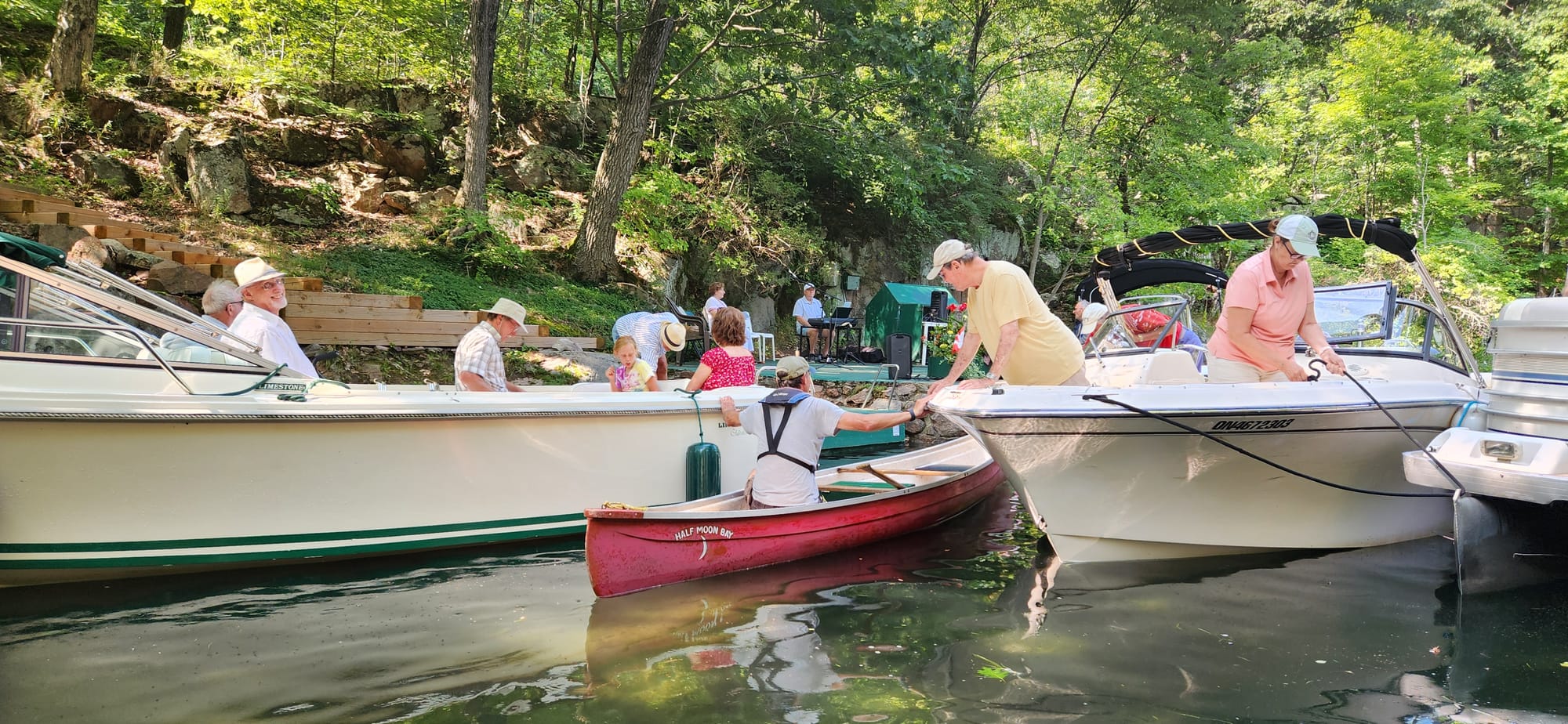
On six Sunday afternoons in July and August, there is a treat in store for you at the natural auditorium formed by rock and the St. Lawrence River, where congregations gather in their boats and listen to the speakers from their granite pulpit and the singers from the rocky shore.
Hope to see you there.
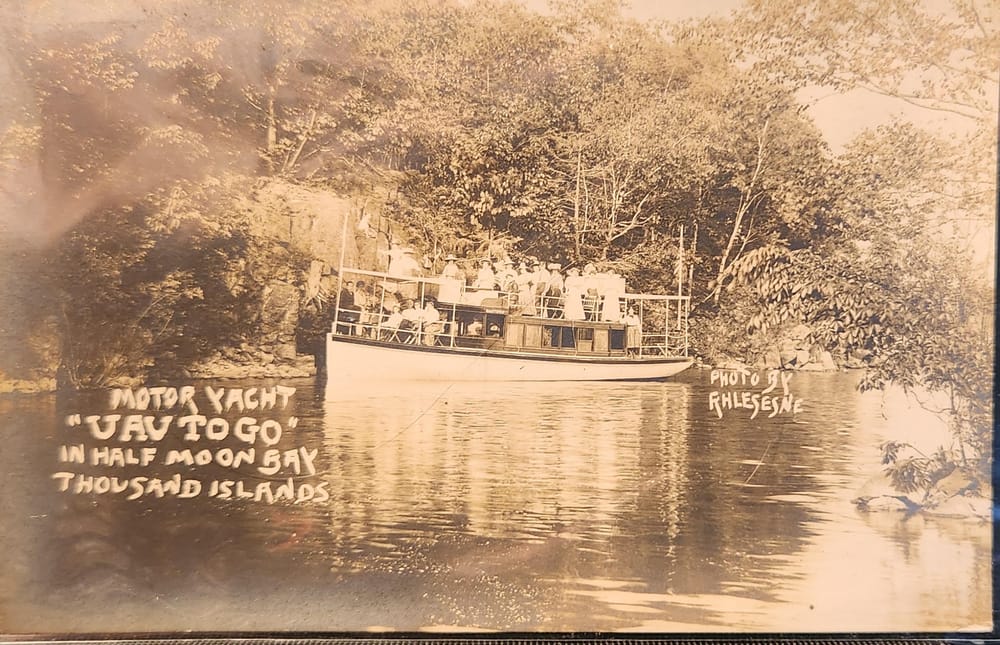
Author's Note: This story grew out of a presentation for the Half Moon Bay Foundation. I was so moved by the early newspaper reports describing how much Half Moon Bay meant to the surrounding River community that I committed to attending a service there this year. My thanks to Tom King, who proofread the story to ensure it flowed and that all the i’s were dotted and the t’s crossed. He shared a postcard from his collection that I’ve used, and he told me he was one of the Boy Scouts who passed out the hymnals and collected the offerings in a canoe. He didn’t ever recall losing any money to a hungry pike, though. I’m also grateful to Susan Weston Smith for asking me to submit the story and for the use of the early Half Moon Bay photos.
By Karen Wand
Karen Wand and her late husband, Rick, lived on the West Coast for many years before returning to the Thousand Islands to be near her family. The theme of family played a significant role in Karen's wish to honor her husband by researching with painstaking detail the story of Rick's great uncle, the talented local boat builder, Jack Malette. Her appreciation of unsung heroes comes through in her writing. See Jack Malette and Tomahawk, April 2013. In 2025, Karen published Canadian Boat Builders of the Thousand Islands and Rideau Waterways. see our TI Life, book review: https://thousandislandslife.com/karen-wands-canadian-boat-builders/