SAR: Thousand Islands Search and Rescue
by: Michael Laprade
As a society, we have been searching for lost people and rescuing those in trouble for a very long time.
Today, Search and Rescue—better known as SAR—is the organized search for, and provision of aid to, people who are lost, injured, in distress, or facing imminent danger.
SAR covers a remarkable number of specialties. There is mountain rescue, ground search and rescue, urban search and rescue, combat search and rescue, and air-sea rescue. And, of course, there are search dogs.
Over the centuries, SAR has evolved into highly coordinated organizations using aircraft, radios, GPS, sophisticated communications systems—and dogs with noses far more impressive than anything technology has yet produced.
Dogs would eventually become an important part of search and rescue, including on the battlefields of Europe.
SAR in the Thousand Islands
Here in the Thousand Islands, we have Search and Rescue capabilities. On the Ontario side, the Search and Rescue (SAR) mandate of the Ontario Provincial Police (OPP) is a unique responsibility.
The Ontario Provincial Police has specially trained canine handlers who form part of its Emergency Response Teams available around the clock. That means the concept of a “day off” is somewhat flexible.
Most working people work certain days and then enjoy the occasional day off, when they can go shopping, attend a doctor’s appointment or visit friends.
SAR teams and their handlers do not have that luxury.
Even when officially off duty, they must remain available for callout. If an officer has something that cannot be interrupted—such as a medical appointment—they must obtain authorization in advance to ensure they will not be called out.
In other words, even their day off has a backup plan.
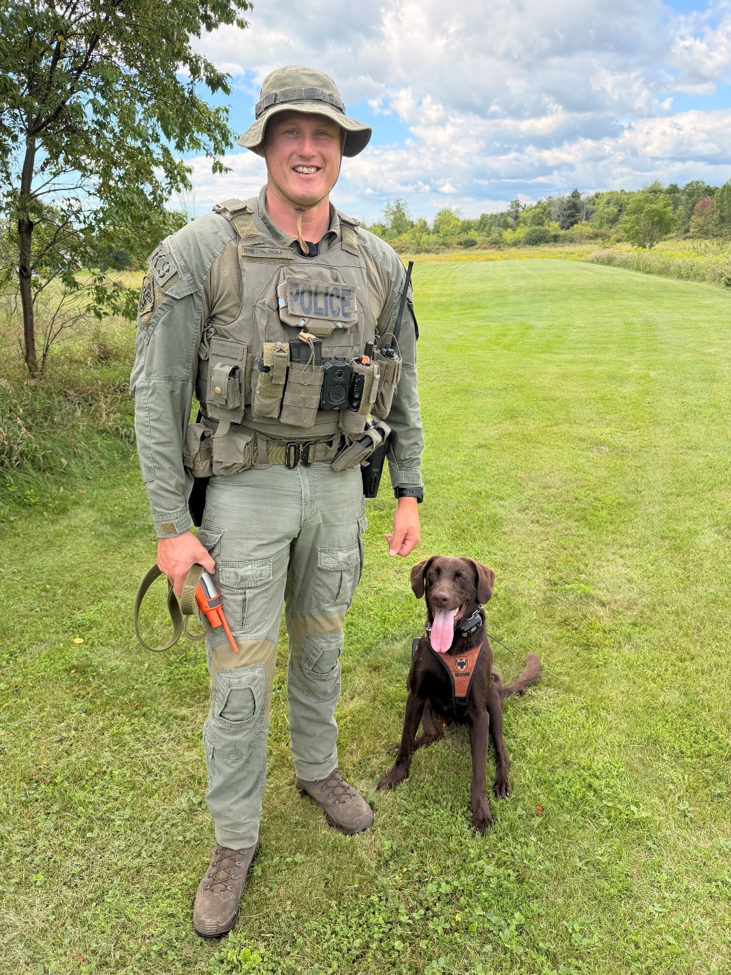
One of our local SAR canine handlers is OPP officer Dale Solf. A former British soldier, 41-year-old Dale immigrated to Canada and joined the OPP 11 years ago. He stands 6 feet 4 inches tall and has a no-nonsense presence. You might assume that if Arnold Schwarzenegger had decided to become a police officer, this is what you would get. But appearances can be misleading.
Behind the imposing exterior is someone deeply committed to rescuing people and protecting the public. Dale is married, has four children, and became a canine handler in 2021.
Between he and five other handlers, they cover all of the areas policed by the OPP in Eastern Ontario. They work with their own highly trained dogs, with very different specialties.
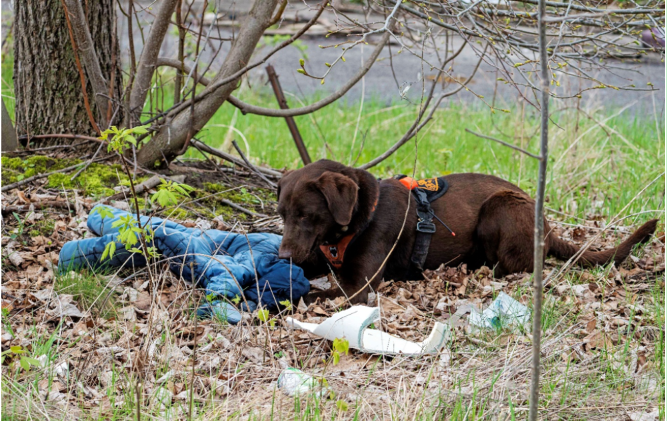
Dales’ first dog is Chip, a 5-year-old Labrador retriever. He is trained in search and rescue, locating lost or missing people in outdoor environments such as wooded areas, as well as detecting human remains.
The other is Haze, a 7-year-old Belgian Malinois. He is a general service dog trained in criminal apprehension, firearms detection, and drug detection.
Together, they cover an impressive range of assignments.
•Lost people.
•Missing people.
•Criminal suspects.
•Drugs.
•Guns.
•Explosives.
•Evidence.
•Human remains
And people who have taken their own lives.
A Nose for Evidence
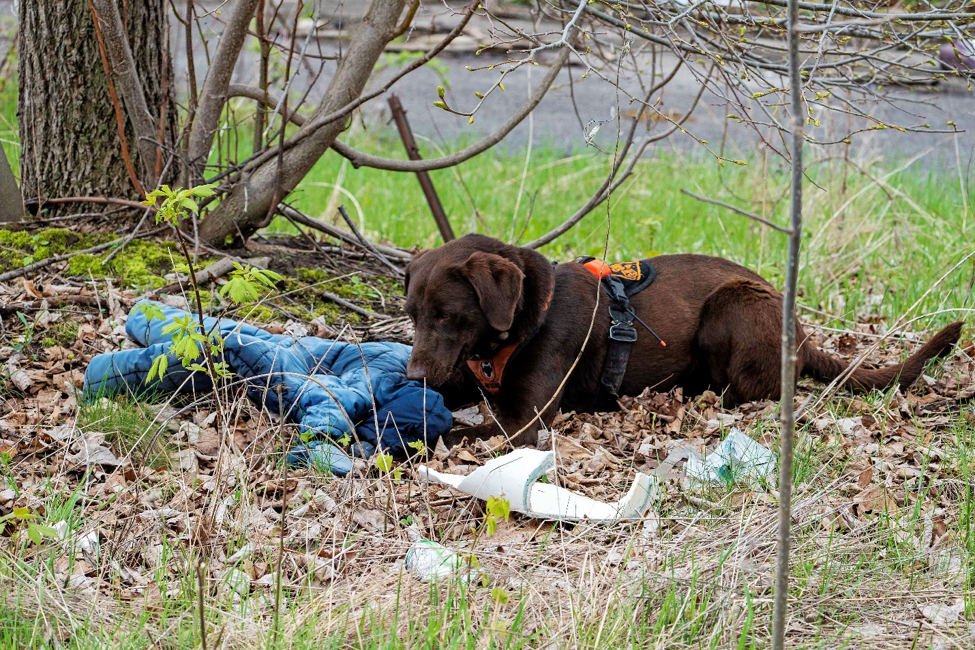
One of the most remarkable aspects of police dogs is their ability to locate small objects over large areas. A dog may be asked to search a field, a wooded area, or a ditch for evidence. The dog does not necessarily know what it is looking for. Instead, it follows the human scent associated with an object.
Perhaps it is a knife thrown into a ditch or a firearm tossed into the woods.
Or something as small as a golf tee pushed into the ground.
Yes, a golf tee.
These dogs have also located spent shell casings buried beneath piles of leaves. When they find an object, they do not simply dig it up and proudly bring it back like a retriever returning a duck.
Instead, the dog lies down, often with its nose only an inch from the object, and points. During one search, officers dug and dug, wondering what the dog could possibly be indicating. The answer was eventually discovered exactly where the dog had said it was. Under his nose.
Training the Team
A canine handler and undergo extensive training together. The process begins with approximately 18 weeks of basic training.
Later, they return for additional drug detection training and advanced instruction. Training does not end once the dog and handler are certified. Like athletes, they must continually train and be evaluated to keep their skills sharp. Search and rescue training can take 10 weeks, with additional specialized instruction required for explosives detection. The handler and dog become a team.
The Call Can Come Anytime
The work is demanding on family life. A planned dinner or a birthday celebration can disappear the moment the telephone rings. Dale remembers visiting friends when he received a call to search for a missing person with Alzheimer’s. The call sent him into a swamp.
For the next 14 hours. The search continued until the person was found. Alive.
When Dale is not responding to a search-and-rescue callout, he returns to his regular duties as a patrol officer. But the next call could come at any time. And when it does, he and his dogs are ready.
The History of the Mercy Dog
The partnership between humans and dogs in rescue work has a long history. By the early 1900s, several European militaries were developing “Mercy Dogs.” During the First World War, thousands of trained dogs were sent to the front lines. These were not guard dogs or attack dogs.
Their job was to find the wounded. The dogs moved through trenches and across battlefields. They carried small saddlebags containing bandages, medical supplies and other necessities. A wounded soldier could administer aid to himself. But the dogs were trained to do more. They distinguished between the dead, the dying, and those who could potentially be saved. If a wounded soldier was discovered, the dog might rip a piece of the soldier’s clothing and return to its handler, helping rescuers locate the injured man.
Some dogs lead rescuers back to wounded soldiers and, in some
cases, even dragging an injured man toward safety. The most touching stories involve soldiers who were too badly wounded to survive. Some describe the dogs simply lying beside them, placing their heads against the dying soldiers so that in their final moments, were not alone.
Over the course of the war, thousands of soldiers were found and
assisted by these dogs. They were called Mercy Dogs. And it is a fitting name.
Still Searching
Search and Rescue has changed dramatically since monks sent dogs into the snow-covered Alps. But one thing has remained remarkably consistent.
When someone disappears, someone has to go looking. Sometimes it
is a volunteer, or a soldier but usually it is a SAR team. With a dog.
A dog with an extraordinary nose, endless energy, and absolutely no interest in whether the search area is a pleasant forest trail or a mosquito-filled swamp at two o’clock in the morning.
For Dale Solf and his canine partners, the call can come at any hour.
A family gathering may have to wait.
Dinner may get cold.
But someone may be lost. And when that happens, Dale and his canine partners search begins.
By Michael Laprade
Michael Laprade and his wife Janice are retired Californians, who spend the summer at their “Honey Bee Island” property. It is located in the International Rift, between Blacksnake Passage at the mouth of Lake of the Isles and the stone span of the US / Canadian Customs Bridge. Michael is a former prison administrator, and also is a Professional Magician. In October 2013, Michael and Janice wrote Honey Bee Island’s Little Free Library for TI Life. Now Michael has joined our regular team of authors and I encourage you to see his past articles here and here. His articles are both interesting and fun!