Interesting Islanders: Tales of a National Park Warden
by: Michael Laprade
Editor's Note: In the coming months we have asked Michael Laprade (Honey Bee Island) to tell us about "Interesting Islanders" - those neighbours or friends who live next door or way downriver. We hope you enjoy this new series and if you have suggestions about those we should meet, let us know.
Tales of a National Park Warden
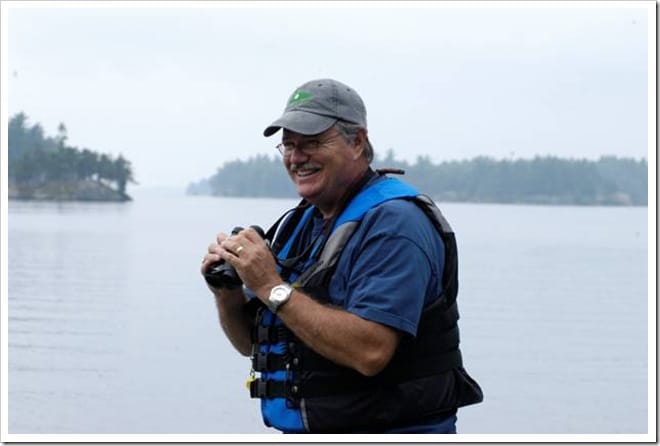
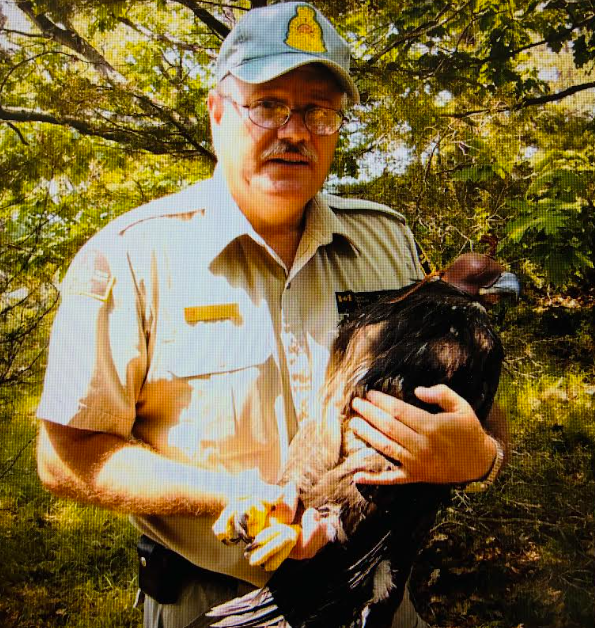
“Bud” Andress spent most of his 37-year career as a National Park Warden doing his level best to protect the Thousand Islands.
Born and raised in Gananoque, he graduated from Queen’s University in Kingston with a Bachelor of Science in Physical Geography.
His love of the River began early. As a boy, he spent eight summers at the Gananoque Canoe Club where he developed boating skills and a deep appreciation for the River that would shape the rest of his life. As a teenager, he worked at the Brennan marina. At this time, he acquired a 15-foot wooden boat, painstakingly repaired and refinished it himself, then powered it with a 40 HP outboard. It was the beginning of a lifelong passion.
Boating was in his blood. His great-grandfather and his grandfather both built boats, beginning in 1890, including the St. Lawrence skiffs and some internationally sought duck decoys, at the family owned Andress Boat Livery in Gananoque. A first cousin later continued the family tradition and operated the W.E. Andress & son Boatworks in Rockport, ON.
Bud began his Parks Canada career as a general laborer at Mallorytown Landing. After successfully completing the selection process, he entered the National Park Warden Service and was sent to Jasper, AB, for extensive training. He returned as a newly minted National Park Warden.
His first post was assignment to the Warden station on Leeward Island, in the Admiralty Group near Gananoque. Bud and his wife Beverley lived in the warden’s cottage for six years during the summer months, always ready to respond to any emergency in his district. Later, he was transferred to the Lindsay Island Warden station, before being promoted to Senior Park Warden.
As Senior Warden, Bud's responsibilities fell into four broad areas: law enforcement, natural resource management, public safety, and forest fire control. A dedicated naturalist and conservationist, he shifted his focus according to whatever challenge demanded immediate attention. During his career, he co-authored numerous wildlife papers and became a sought-after speaker for local schools and community organizations. In 2008, he was awarded The Keeper of The Islands award by the Thousand Islands-Gananoque chamber of commerce.
His experience ranged from search-and-rescue operations and firefighting to joint operations with American and Canadian agencies. Winter brought a different set of responsibilities. Equipment had to be maintained, natural resources monitored, and the islands patrolled by snowmobile, snowshoe, and cross-country skis to deter poaching.
His patrol area stretched nearly 90 kilometers—from Cedar Island, near Kingston, to Stovin Island in the Brockville Narrows. It wasn't unusual to break up a drunken party on an island near Brockville at midnight, only to be dispatched immediately afterward to another disturbance closer to Kingston. In those days, alcohol-fueled parties and unattended campfires were common weekend occurrences.
The Power Cable
Over the years, Bud encountered countless situations that demanded quick thinking and calm under pressure.
One summer day, while patrolling near Prince Regent Island at the Gananoque Narrows, he noticed two men in a fishing boat frantically waving for help. Other passing boaters mistook the desperate gestures for friendly waves and continued on their way.
When Bud pulled alongside, the fishermen explained that their anchor had snagged something on the bottom. A closer look revealed the real problem.
The propeller of their inboard-outboard motor had wrapped the anchor line and chain around a submerged hydroelectric power cable, pulling the heavy cable to within inches of the surface. The chain was wound so tightly around the propeller that it couldn't be removed.
Fortunately, Bud always carried a pair of bolt cutters aboard his patrol boat.
He leaned over the stern and tried cutting the chain, but the awkward angle and cramped space defeated him. Refusing to give up, he had the fishermen hold onto his belt while he hung nearly upside down over the transom, straining to reach the tangled chain. Even then, the jaws of the bolt cutters were too large to get a proper bite.
As he struggled, something caught his eye.
A three-deck Gananoque tour boat, carrying hundreds of passengers, was approaching on a course that would take it directly over the nearly exposed power cable.
His mind raced.
If the tour boat's propeller snagged the cable, would it sever it?
Could the cable become energized and endanger the passengers?
Would the propellers become hopelessly entangled, leaving the vessel disabled in the middle of the channel?
Within moments, a routine call had become a potential catastrophe. As the bow of the tour boat was approaching the cable, Bud summoned every ounce of strength for one final attempt. This time, the bolt cutters bit cleanly through the chain.
The anchor dropped free, and the heavy power cable instantly slipped beneath the surface, disappearing into the River.
The tour boat passed safely overhead. Passengers on deck smiled and waved, completely unaware of how close they had come to disaster.
The False Rescue
One of the most harrowing nights of Bud's career came on November 11, 1989.
A report had come in that distress flares had been seen near the Summerland Islands.
It was exactly the sort of night that begins every sea story: dark, windy—and bitterly cold.
Bud and his crew launched two patrol boats from Mallorytown Landing and headed toward the reported location. The River was savage. Towering waves pounded the boats, while icy spray crashed over the windshields of the open patrol craft. Every foot became a battle against the elements.
Although they were responding to save someone else's life, there were moments when they wondered whether they might lose their own.
In nearly three decades on the River, Bud would later say those were the worst boating conditions he had ever experienced.
Still, they pressed on.
After reaching the area, they searched tirelessly but found no vessel in distress. As the weather continued to deteriorate, the difficult decision was made to end the search and return to shore.
Only later did they learn the truth.
Someone had reported the distress flares as a prank, simply to watch the emergency response.
Bud never spoke harshly about people, but this incident remained one of the most frustrating of his career. While his crew had risked their lives battling hurricane-like conditions, someone had been amused by the spectacle.
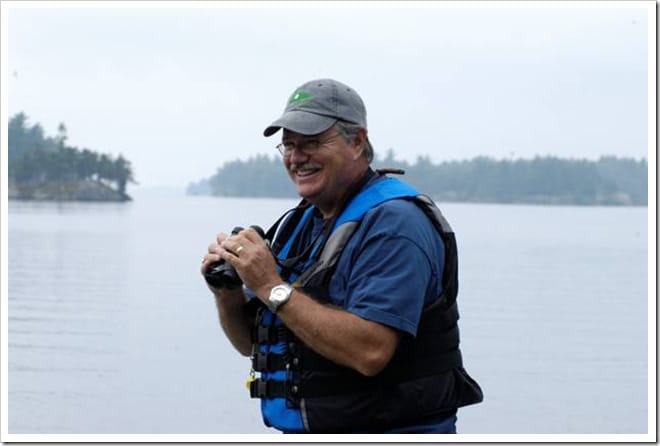
For Bud Andress, being a National Park Warden wasn't simply a job. It meant protecting the parks, preserving wildlife, enforcing the law, and, whenever necessary, risking his own life so that others could return safely home.
Fortunately for the Thousand Islands – and its people – men like Bud have answered that call for nearly three decades.
By Michael Laprade
Michael Laprade and his wife Janice are retired Californians, who spend the summer at their “Honey Bee Island” property. It is located in the International Rift, between Blacksnake Passage at the mouth of Lake of the Isles and the stone span of the US / Canadian Customs Bridge. Michael is a former prison administrator, and also is a Professional Magician. In October 2013, Michael and Janice wrote Honey Bee Island’s Little Free Library for TI Life. Now Michael has joined our regular team of authors and I encourage you to see his past articles here and here. His articles are both interesting and fun!