“Boy, it’s pea soup out there today”!
by: Tom King
Fog! That one word can unsettle even the most experienced mariners. When it becomes dense enough to reduce visibility to nearly zero, navigation without proper instruments can be almost impossible. With landmarks, shoreline features, and the horizon obscured, boaters can quickly become disoriented. I have heard stories of boaters searching for their way through heavy fog, only to discover once it lifted that they had been travelling in circles the entire time.
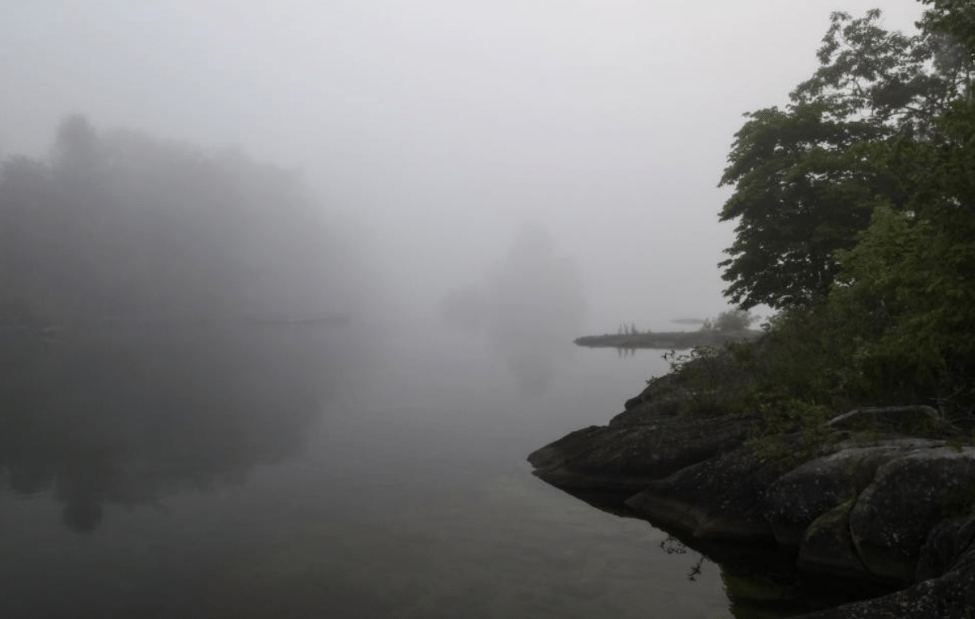
What exactly is fog? A common description is that it is a stratus cloud resting near the ground, although that is a bit simplistic. Fog is made up of minuscule water droplets suspended in the air, which forms when the invisible water vapour cools and condenses around tiny particles, such as dust, pollen, or pollution.
From a meteorological perspective, fog forms when the temperature and dew point of the air approaches the same value, either by adding enough moisture to raise the dew point or by cooling the air temperature down. The dew point is defined as the temperature at which air becomes saturated with water vapour and is unable to hold any additional moisture and is a function of both the ambient temperature and the relative humidity.
An approximation of the dew point can be calculated using the following formula:
Dew Point = T – ((100 – RH)/5)
Where:
T = the air temperature in degrees Celsius.
RH = the relative humidity in percent.
Fog can form in several ways, leading to seven distinct classifications. Nearly all types consist of tiny water droplets suspended in the air. The exception occurs in very cold conditions when water vapour forms tiny ice crystals instead; this type is known as ice fog.
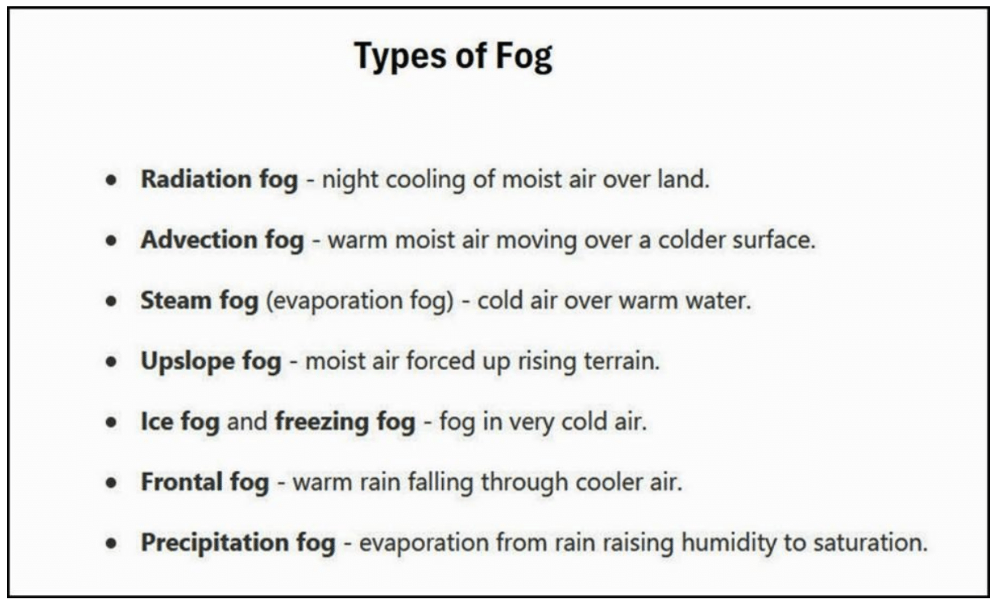
Fog can form in any season. In our area, it is most common in spring and early summer, especially over open water. It also occurs along shorelines in autumn, and steam fog may occasionally develop during the coldest winter months.
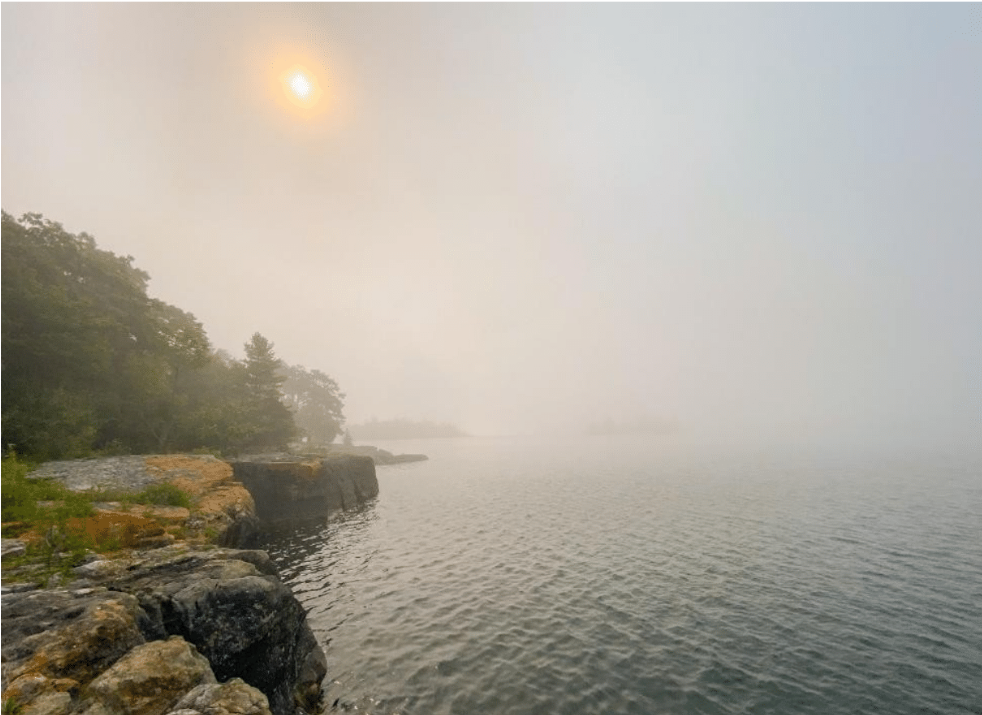
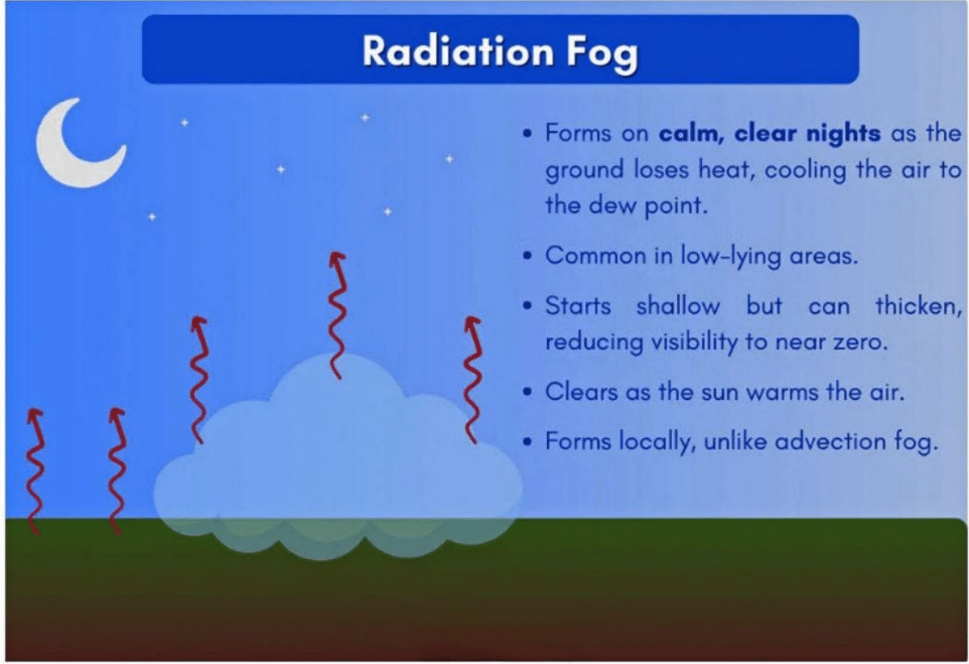
Radiation fog typically forms overnight on clear nights, when the Earth’s surface loses heat rapidly into the atmosphere without cloud cover to slow the cooling. This cools the air near the ground to its dew point. As a result, water vapour condenses into visible fog droplets. Because radiation fog occurs under calm conditions, or very light winds, there is just enough air movement to mix moisture through a shallow layer near the ground without dispersing the fog. Radiation fog usually develops onshore and may drift over the water in the early morning. It is generally less dense and less persistent than advection fog, and it often lifts by noon as the sun warms the surface or stronger winds break it up.
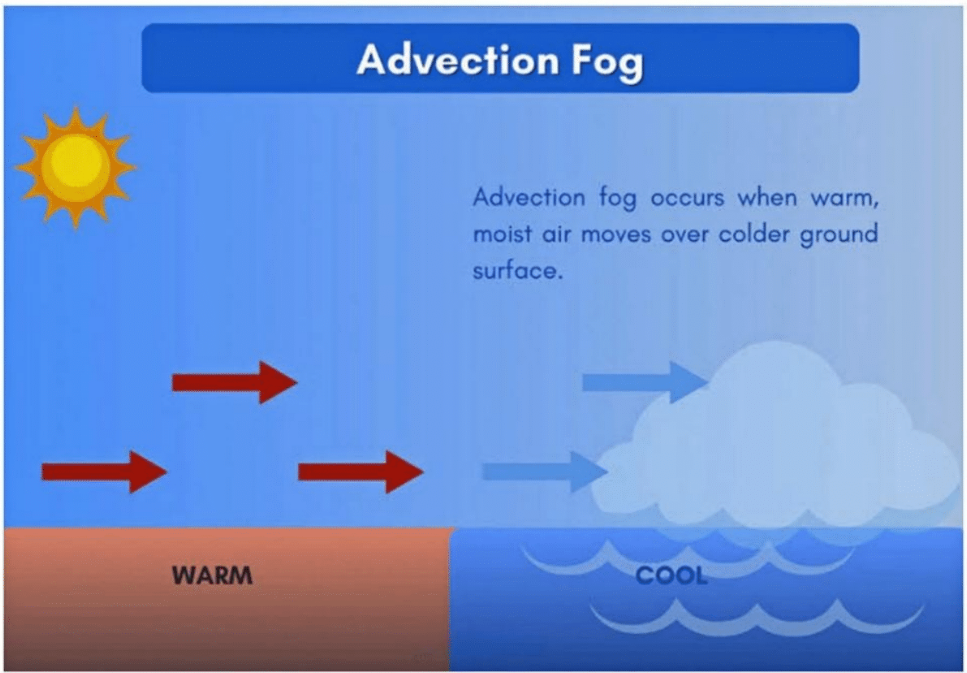
Advection fog is usually the densest and most widespread type. It forms when warm, humid air is blown over a colder surface, such as water, snow, or land. The moving air cools to its dew point, causing moisture to condense into tiny, suspended droplets. Unlike radiation fog, advection fog can develop day or night and often persists because the wind continually brings in more warm, moist air. It may last for days. If winds are too light, radiation fog may form instead; if they are too strong, the fog may lift into a low-level stratus cloud.
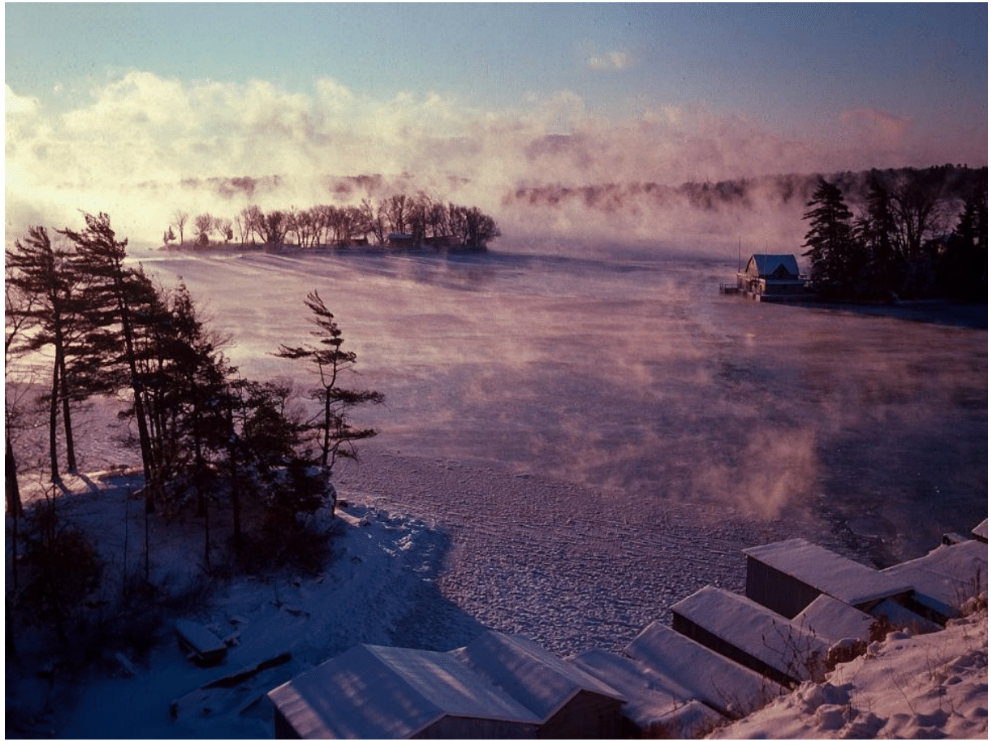
Steam fog, also referred to as arctic sea smoke, forms when frigid air moves over much warmer water. The warmer water evaporates rapidly into the colder, drier air above, saturating it. As this warm, moist layer rises, it cools quickly and condenses into tiny droplets, creating a dramatic, low-lying fog just above the water. Its name comes from the way the rising moisture resembles smoke drifting up from the water’s surface. Although most common in polar regions, sea smoke can form anywhere in winter when extreme cold fronts pass over warmer, unfrozen lakes, rivers, or ocean currents. It can range from about one to 1,500 metres deep and is often wispy rather than extremely dense.
Precipitation fog is a type of fog that forms when warm rain falls from a higher altitude into a layer of colder, drier air near the Earth's surface. The falling precipitation evaporates, adding moisture to the cool air and increasing its dew point. Once the temperature and dew point of the air mass become equal (or within about 2°C of each other), the air becomes completely saturated, and the water vapour condenses into suspended droplets, creating fog.
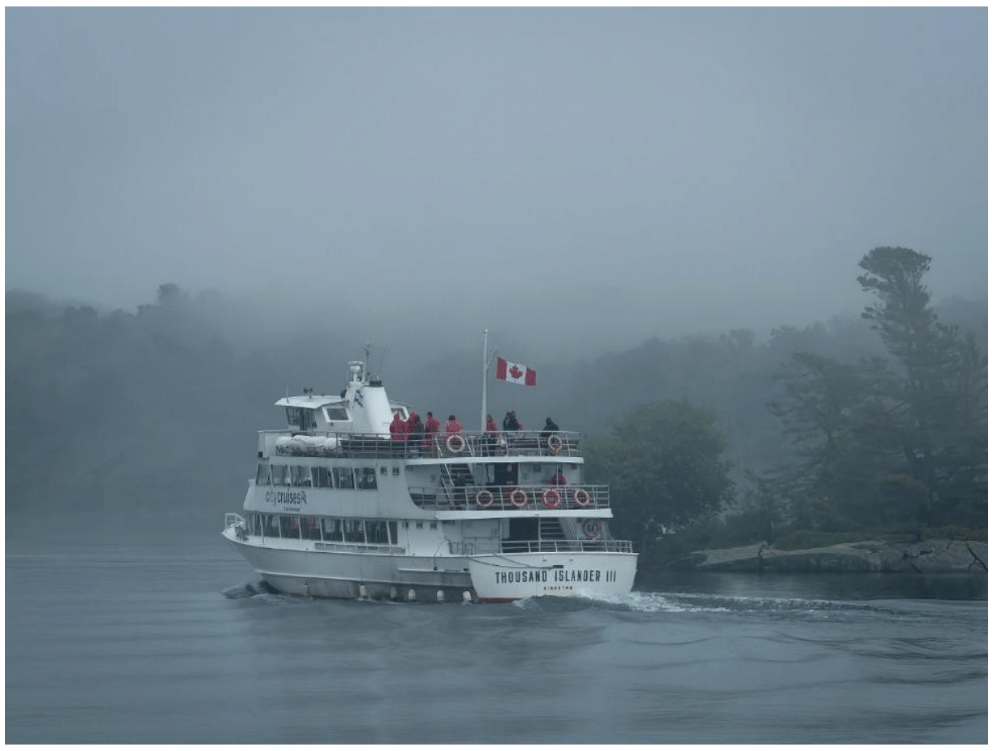
You have probably heard the term “pea soup” used to describe very thick fog. The expression originated in London, England, in Victorian times, during the height of the Industrial Revolution. Dense fog forming over the River Thames drifted ashore, where it mixed with sulphur dioxide and soot from thousands of coal fires burning across the city. The result was a toxic, greenish-yellow smog that resembled a steaming bowl of pea soup. Although clean air legislation and more efficient combustion methods eventually eliminated these foul “pea soupers,” the term has endured and is now used to describe very dense fog.
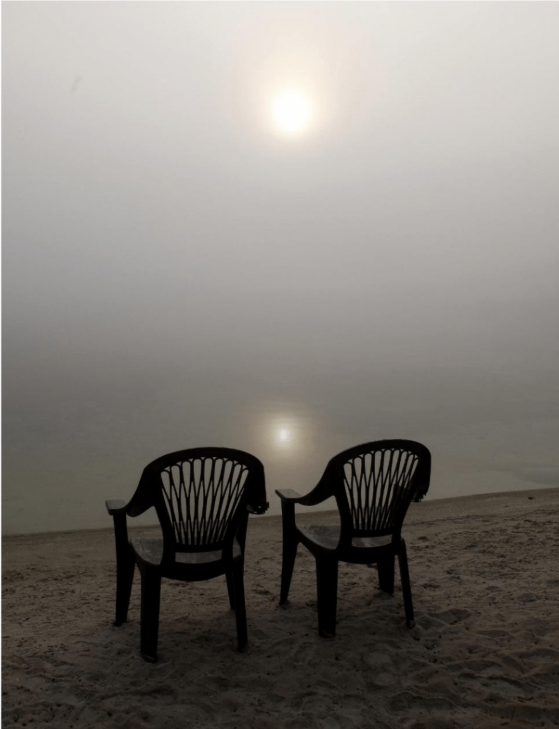
One phenomenon you may see on a foggy day is a fogbow. Similar to a rainbow, but nearly colourless, it forms when the sun is behind you and a thin bank of fog lies ahead. Sunlight passes into the fog, where tiny droplets refract and reflect it back toward you at a specific angle, creating a pale arc. Fogbows most often appear as fog is approaching or receding and they don’t tend to last very long.
A fogbow has little or no colour because fog droplets are extremely small—sometimes up to 1,000 times smaller than raindrops. Their tiny size makes diffraction more noticeable than in a rainbow. As light passes through the narrow spaces between droplets, it bends and spreads, causing the colours to merge into white. In a well-defined fogbow, you may still see a faint reddish tint on the outer edge and a bluish tint on the inner edge.
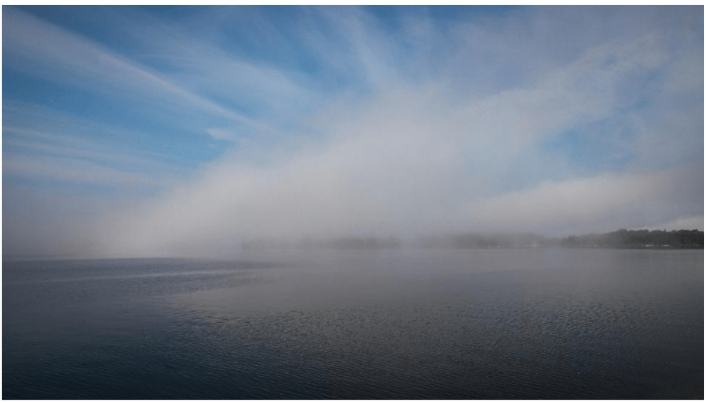
Navigating on the water in dense fog certainly presents many challenges to the skipper. The loss of visibility means that instruments such as radar, GPS (Global Positioning System), AIS (Automatic Identification System), chart plotters and a compass become crucial to maintain course and identify objects or other vessels along the way. In cases where visibility is almost zero the most prudent course of action is to stay off the water until the fog clears.
Another piece of equipment that plays a vital role in low visibility navigation is the foghorn. These acoustic signalling devices may be land-based, typically located in a lighthouse, to warn vessels of navigational hazards, such as shoals or rocky coastlines, or mounted on ships to alert other vessels in the area of a boat's presence to prevent collisions.
There is a scientific reason why foghorns emit their characteristic deep, booming, resonant tones. The low-pitched sounds they produce have longer wavelengths that travel much farther and are less easily absorbed by atmospheric interference like dense fog, unlike high-pitched sounds which tend to dissipate and lose energy much more quickly over long distances.
Because several fog signals may be heard in the same area, each working foghorn uses a distinct timing pattern. For example, one may sound for 5 seconds every 30 seconds, while another may give a 7-second blast every 90 seconds. These patterns help mariners determine which lighthouse or hazard they are hearing.
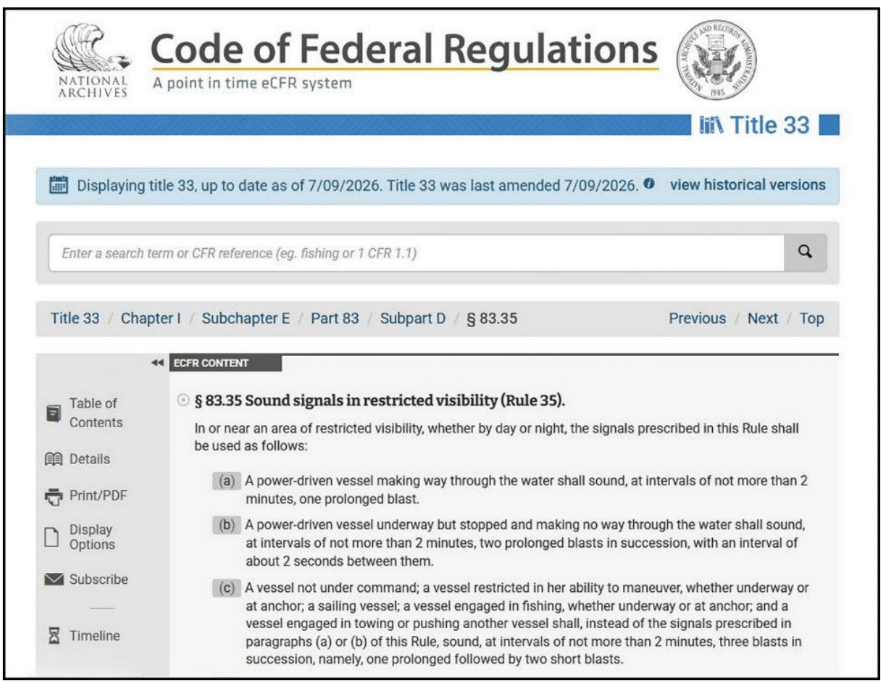
There are complex sets of regulations that cover what type of acoustic signalling devices are required on different classes of vessels and how they are to be used. One such piece of legislation found in the U.S.A.’s Code of Federal Regulations is known as “Rule 35”. There are also several rules specific to the St. Lawrence Seaway that dictate operational procedures for limited visibility navigation, including a threshold distance where vessels must stop until conditions improve to an acceptable level.
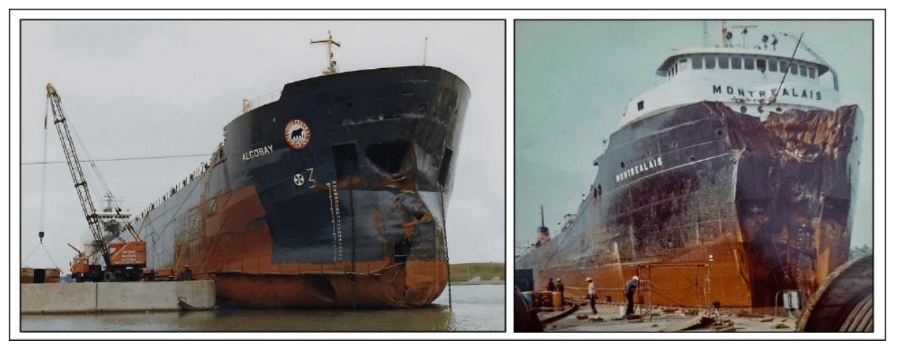
Despite all the rules and regulations pertaining to low visibility navigation, and the availability of modern technology to aid in keeping vessels on course, accidents do still happen in the fog. One such incident occurred back in June of 1980 when two large freighters collided head-on just off St. Clair, Michigan, on the St. Clair River. One ship, the MONTREALIS, suffered extensive damage to the bow while the other, the ALGOBAY, escaped with much less harm. Both ships were able to make it safely to port under their own power for a damage assessment and, fortunately, no lives were lost in the collision. In the ensuing investigation it was determined that the ALGOBAY was at fault and was liable for seventy-five percent of the $1.5 million damage done to the MONTREALIS.
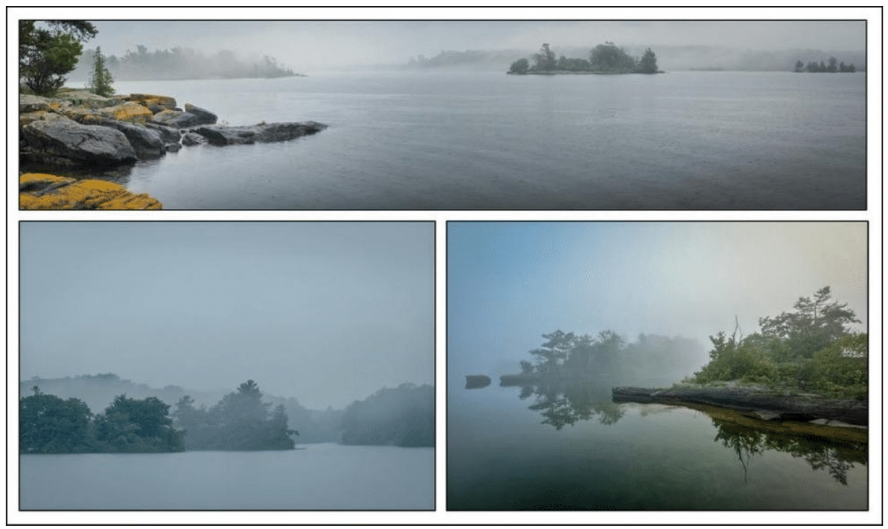
On a personal note, as an amateur photographer, I love shooting photographs in the fog. A foggy day at the cottage provides great opportunities to capture some wonderful images. Whether it be a neighbouring island slowly appearing through a thinning haze or a spiderweb covered in water droplets due to the saturated air, there are always unique photographs to be captured. It’s just a matter of being in the right place, at the right time, with camera in hand.
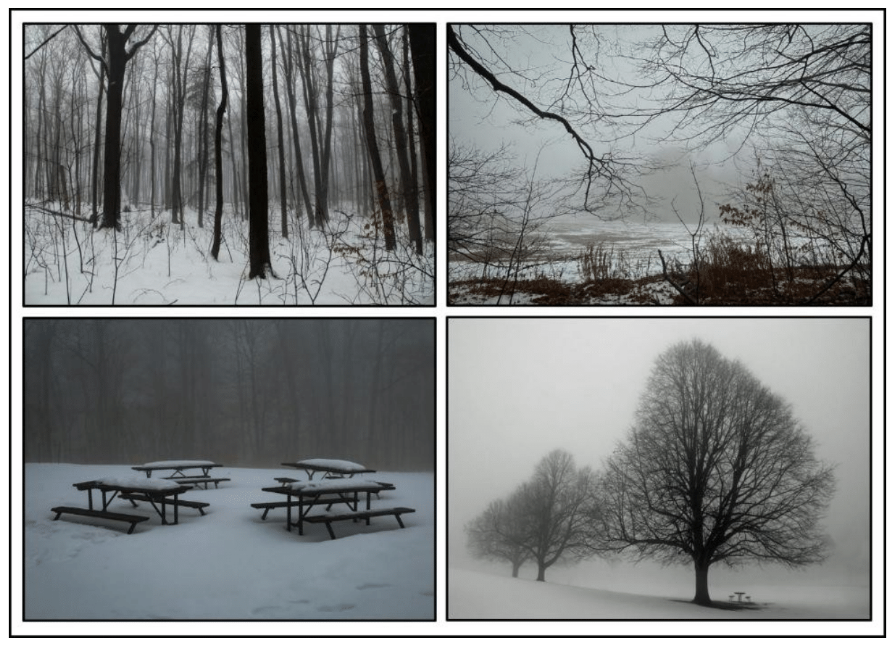
We live close to a couple of conservation areas that are up on the Niagara Escarpment, and they are prime spots for foggy conditions. If things are starting to get a bit hazy in town I can pretty well be assured that the parks will be shrouded in a thick blanket of dense fog due to their higher elevation. I particularly like capturing images in the winter, with some snow on the ground – even though I am taking colour photos they look like they were shot in black and white.
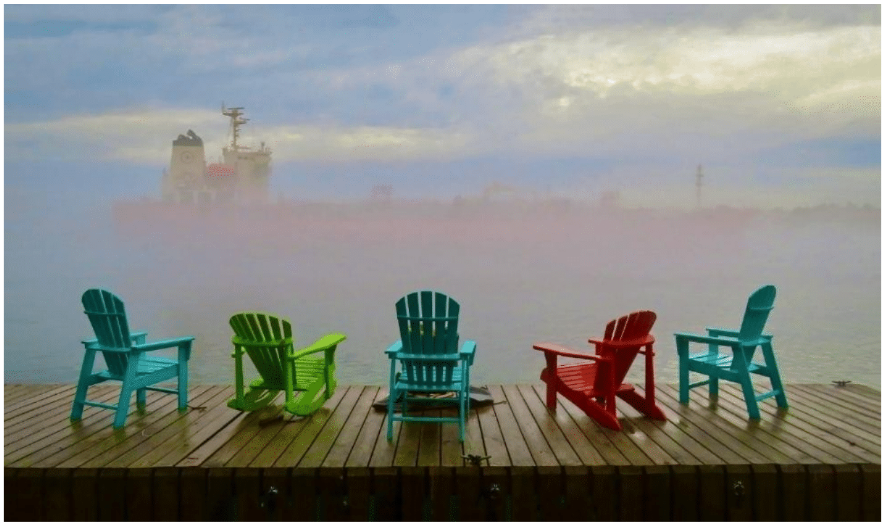
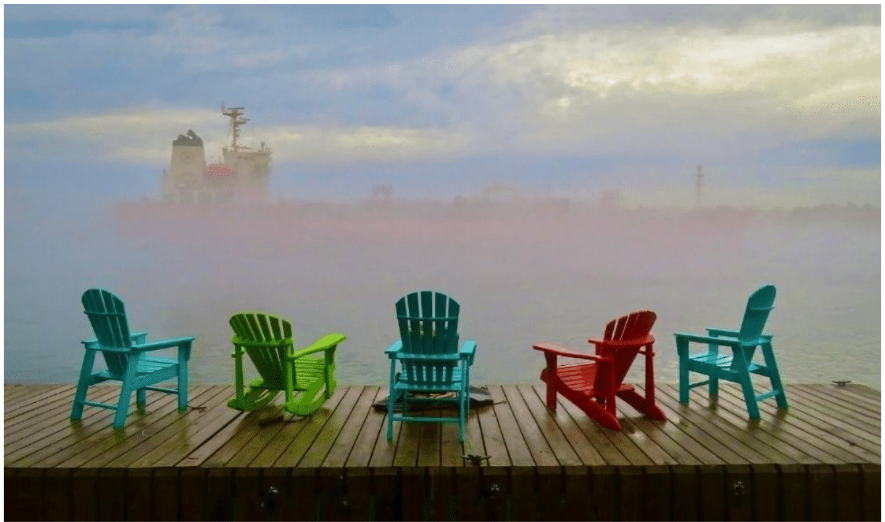
Author’s Note: I would like to thank James R. Miller for graciously allowing me to use his image of the freighter passing by in the fog. You can find more of James’ wonderful photography on his 1000 Islands River Rats Now and Then Facebook page
By Tom R. King
Tom King and his wife Marion have lived in Milton, Ontario, for the past 38 years, where they both worked and raised their family of three children: Thanks to Tom Hunt for the great story on the Pea Soup Fog. Have so many memories of seeing the fog and can still hear fog horns in my head. Kris, Mike, and Becca. Tom's many TI Life articles have captured the history of the tour boat industry as well as giving us the best spider story in the past 19 years!
Read more articles by Tom here in our new format for TI Life, and more articles on our old site.
Comments:
Thanks to Tom King for the great story on the Pea Soup Fog. Have so many memories of seeing the fog and can still hear fog horns in my head.