Voyage to Antigua on "Palawan"
by: Rick Casali
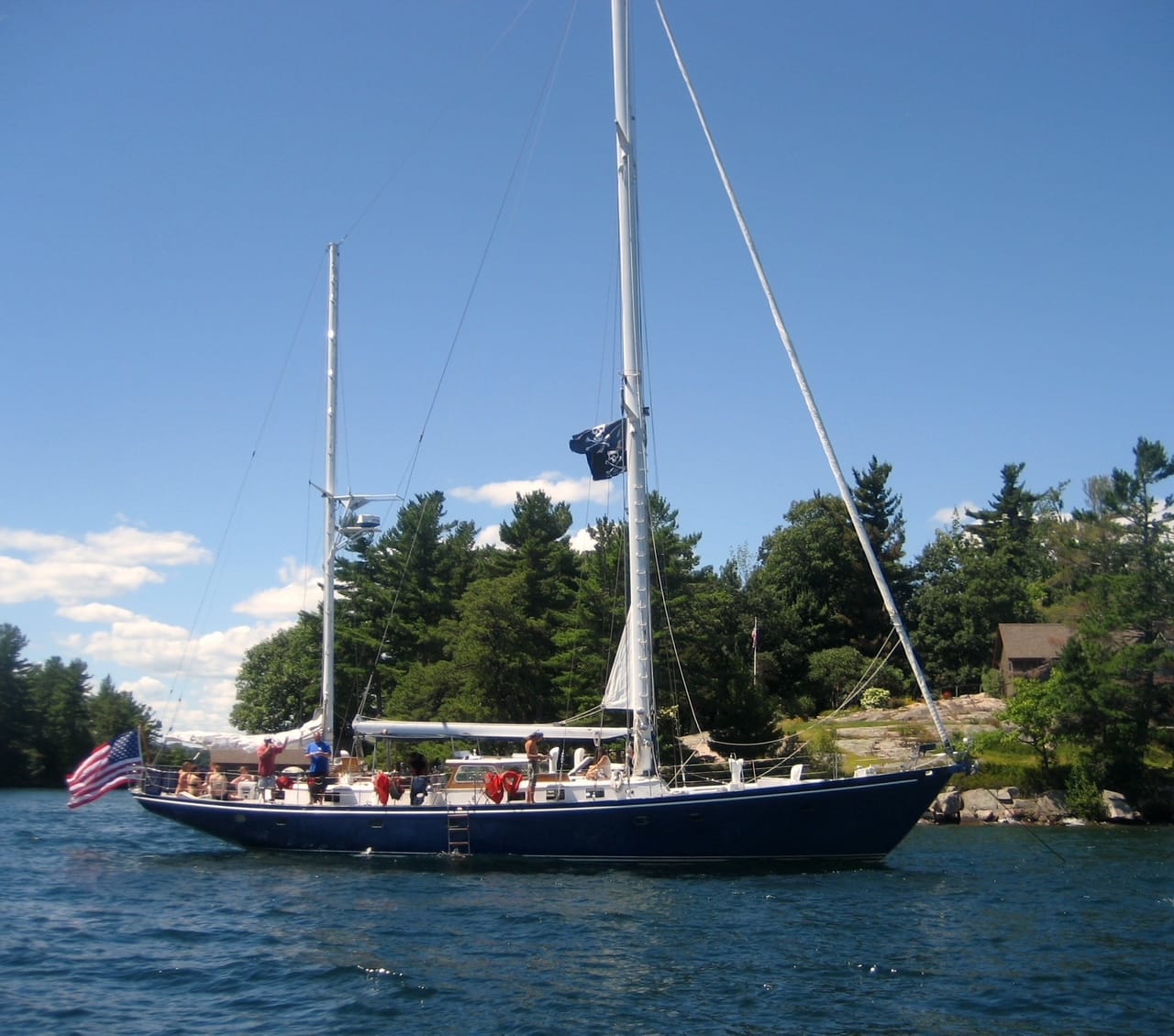
Over two years ago, I wrote about a famous sailboat named Palawan that was anchored in the Thousand Islands. Anne and I were taking an afternoon cocktail cruise in our 21-foot center console, and there anchored by Douglas and Deer Islands was a 68-foot ketch with a very familiar shape. We motored over and I asked the crew if this dark blue ketch was formerly named Palawan. Surprised that she was recognized by her original name, they said “yes,” she was indeed the famous design by Sparkman & Stephens. This article chronicles my earlier 1,200 nautical mile voyage in this aluminum beauty.
Back in 1977, my dear friend Cornelius “Neil” Froeb told me that his cousin Olive Watson had offered him their pretty sailing yacht for a long weekend on the Chesapeake Bay. Palawan was owned by Olive and her husband Tom Watson, Jr., of IBM fame. The yacht was crewed by a captain and a mate. So, my fiancée and I joined Neil and his wife Katherine for a wonderful cruise to the Eastern Shore of Maryland aboard Palawan.
When we met the yacht at the Annapolis city dock, a crowd was gathered around the 68-foot ketch. Verna and I marveled at the size of Palawan. She was graceful yet powerful in her design. The tall rig flew the New York Yacht Club burgee at the masthead.
We cast off for a wonderful, breezy, October cruise up the Miles River and anchored in Eastern Bay. It was a chilly weekend, so the thick down-filled comforters were welcome at bedtime. The captain was German-born Paul Wolter, who was quite a character. He hated running the big GM diesel, so we tacked up the narrow Miles River. Since Palawan drew 12 feet with her centerboard down, we tacked many times. We worked up a good sweat. During this cruise, Neil asked me if I would like to crew on Palawan for a delivery from Bermuda to Antigua, where the Watson’s owned a lovely home. I said yes, so Verna and I changed our honeymoon plans, and made reservations at the Princess Hotel.
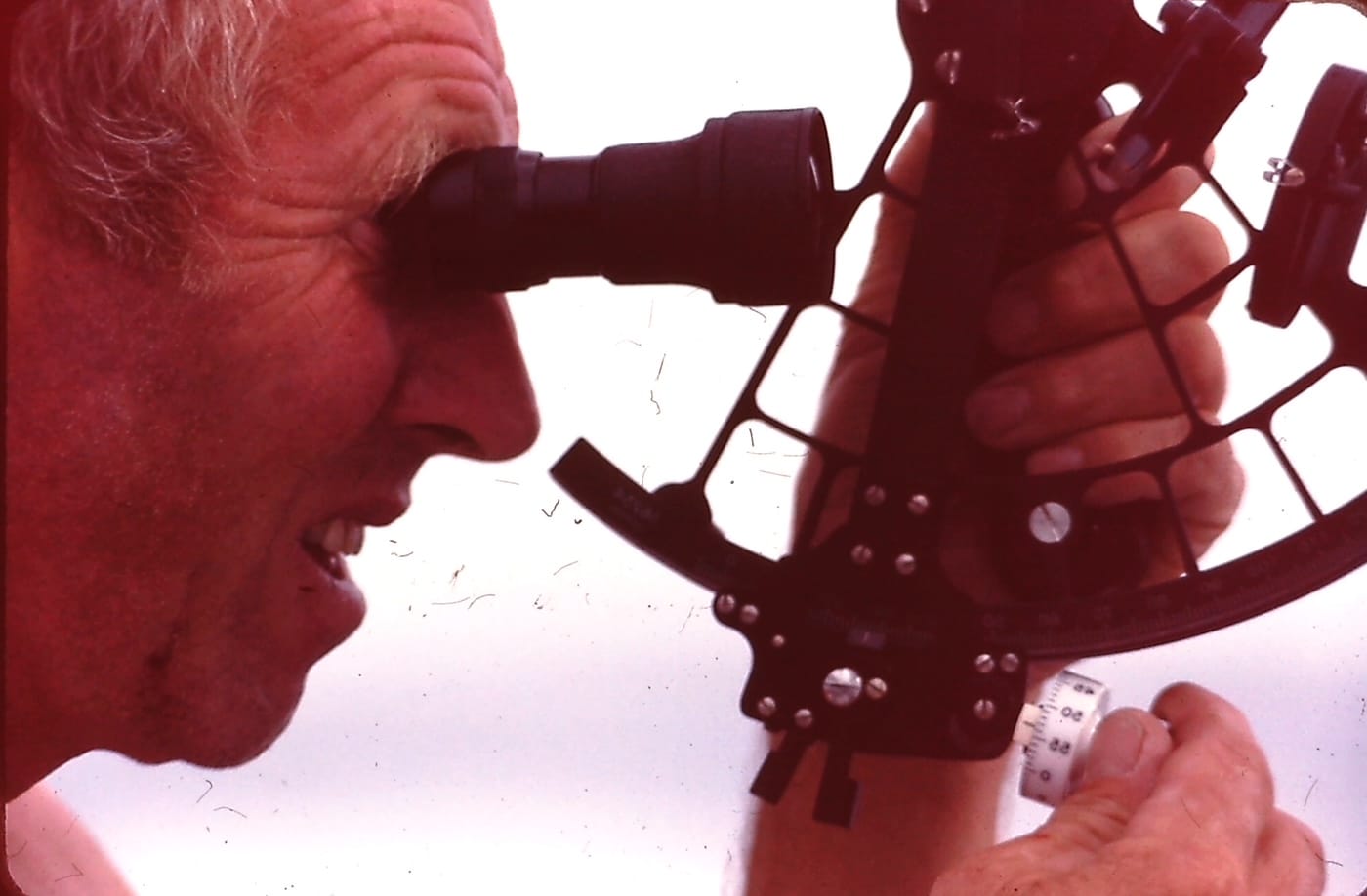
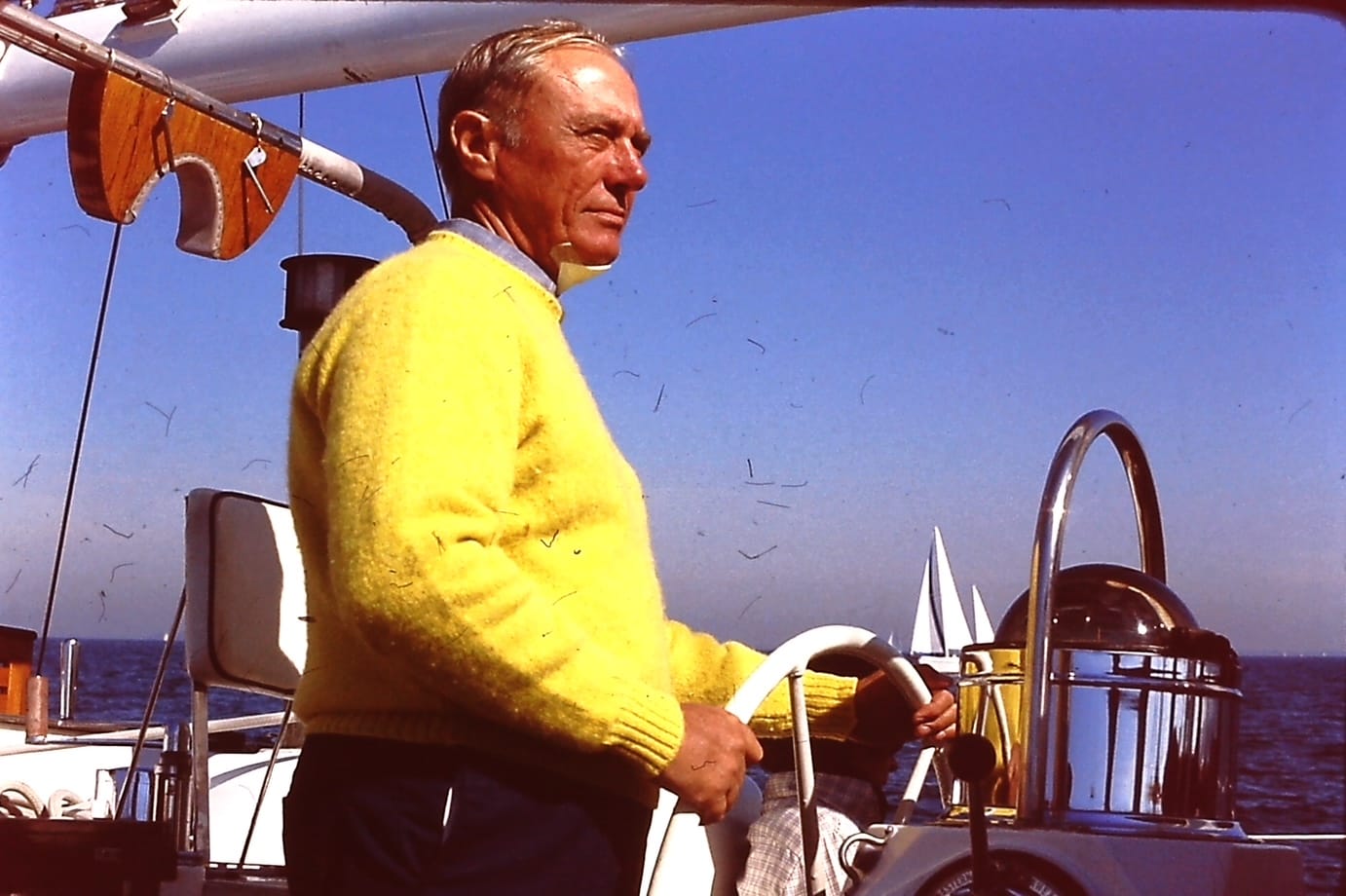
L: Capt Paul Wolter taking a sun set on Palawan en route to Antigua; R:Neil Froeb at the helm of Palawan on the Chesapeake Bay. [Photos courtesy of the author]
After a nice honeymoon in Bermuda in mid-November, I put Verna on a plane back to Maryland, and I cast off with the crew of Palawan for our long journey. Another natural gas industry buddy joined us, so we had a crew of five: Neil, Captain Paul, mate Brian, our friend Todd, and me. A watch schedule was devised of four hours on watch during the day and three hours at night. Captain Paul did not stand watches. Rather, he did the cooking, navigating, and relieved the watch at mealtimes. This worked out reasonably well. At night, the only light shining on the boat was the red light on the compass. Therefore, standing watch alone in the cockpit steering the big 68-footer was daunting at first.
Paul did not believe in using the autopilot as he felt most crewmen would fall off to sleep with this device. So, we hand steered the big ketch the entire 1,200 miles! He also did not believe in using the Decca/Raytheon GPS as it drew lots of electrical current. This was a very early GPS, and it was very large and resembled the first microwaves. So, it sat turned off for most of our trip. Paul and Neil took sun, star, and moon shots with the brass sextant to estimate our position on paper charts.
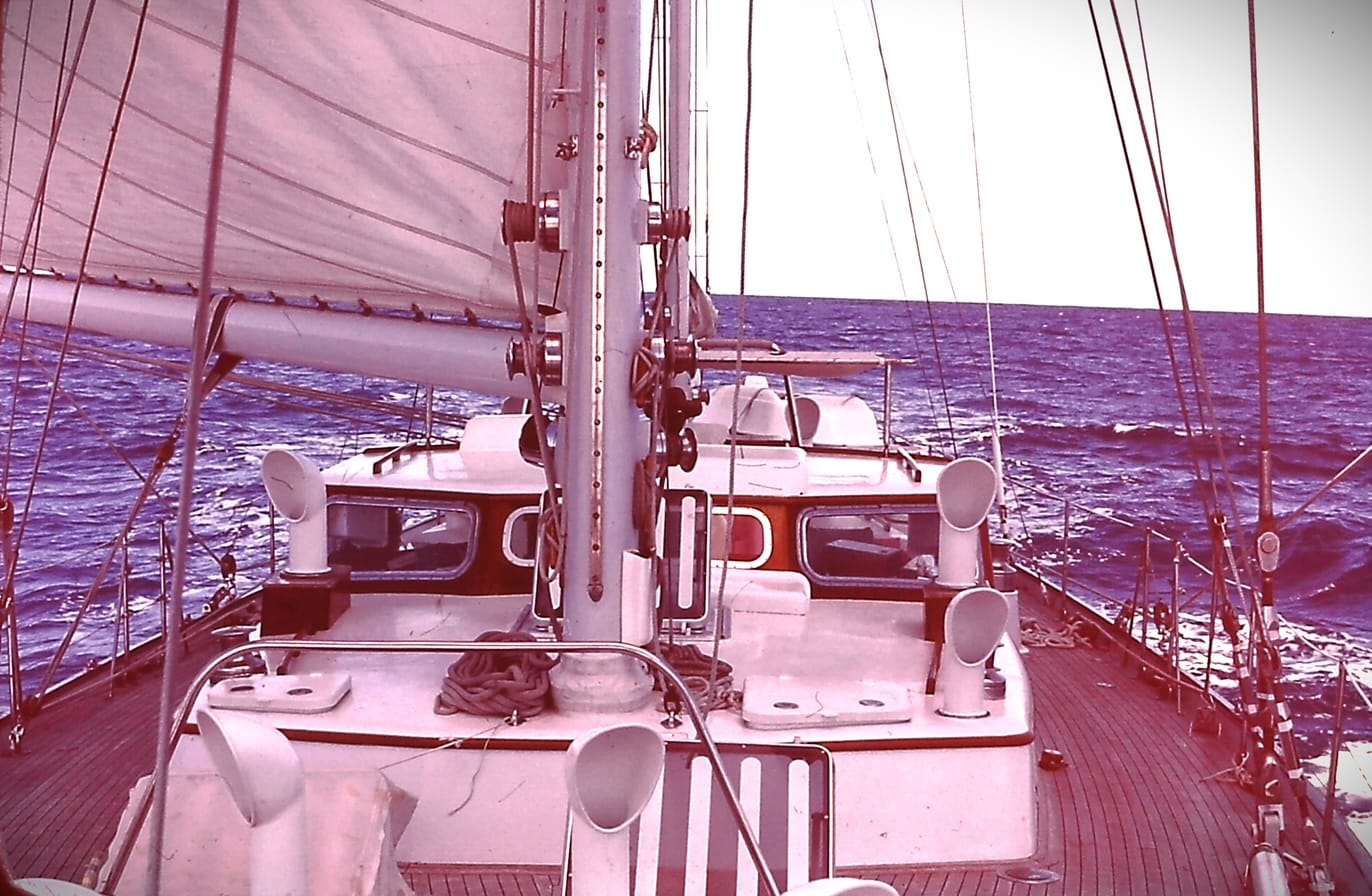
Palawan on a spinnaker run in the Sargasso Sea [Photo courtesy of the author]
Old school to be sure. Paul’s philosophy was ‘his way or the highway.’
Life aboard Palawan was one of daily routines. Standing watch, reading, preparing meals, daily showers on deck, some fishing, and lots of napping. The large dining table in the yacht was gimbaled so that it was level regardless of whether we were on a port or starboard tack. This feature worked reasonably well except if you were on the windward side since the table was up close to your chin when the wind arose. Paul’s cooking was reasonably good, and Neil baked his five-grain bread almost every day. The yacht was well provisioned with lots of frozen meat, chicken, and fish. Our liquor and wine locker was also well provisioned. So, the well-fed crew was happy.
We flew the large red and white spinnaker many days during the voyage. Palawan would surf down the large rollers from Africa on our bow. The yacht would hit 14 knots at the trough of the wave and slow down to 9 knots at the next crest. Steering was easy on the aluminum ketch, not requiring much effort to maintain course. The S&S design tracked extremely well. The large winches easily handled the loading of the foresails, spinnaker, and mainsail. Our rule was that the watch captain could not leave the cockpit during the day or night without
summoning other crew for needed adjustments or sail changes. Safety was important on Palawan.
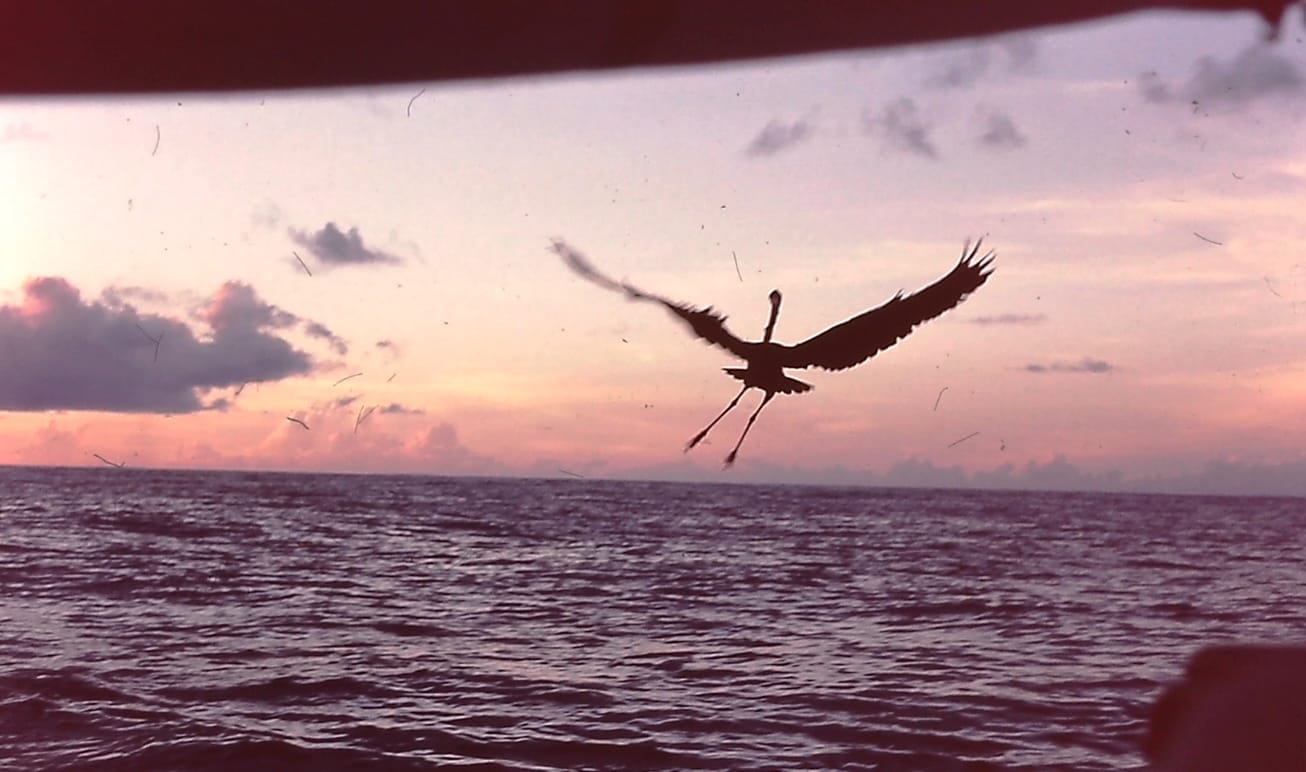
We saw only one other yacht as we made the trip. No commercial ships were spotted as I recall. The Bermuda Triangle has a reputation for rough conditions, but we only had a few squalls. The Sargasso Sea was relatively calm during our delivery. At night, the watch could be surprised by a flying fish coming into the cockpit or a pilot whale or porpoise sounding nearby. We had a Blue Heron land on our port rail for a brief rest before taking off. Being over 900 miles from shore, we wondered if it survived. Also, over 20 purple martins landed on our aft deck and hid under the upturned dinghy. We provided the birds with breadcrumbs and water, but slowly they all perished. They must have been blown offshore in a storm.
Palawan had been designed by Sparkman & Stephens for Tom Watson. A mock-up of the interior was built in plywood to see how the design worked for Olive and Tom. The yacht was built by Abeking & Rasmussen in West Germany and was constructed of aluminum. The center cockpit layout had the saloon, galley, and nav station amidships. The owners’ stateroom and head were aft with a private companionway to the rear deck. Three staterooms and second head were forward, and crews’ quarters were in the bow. The interior was done in varnished teak. Two lovely oil paintings of Palawan were in the saloon.
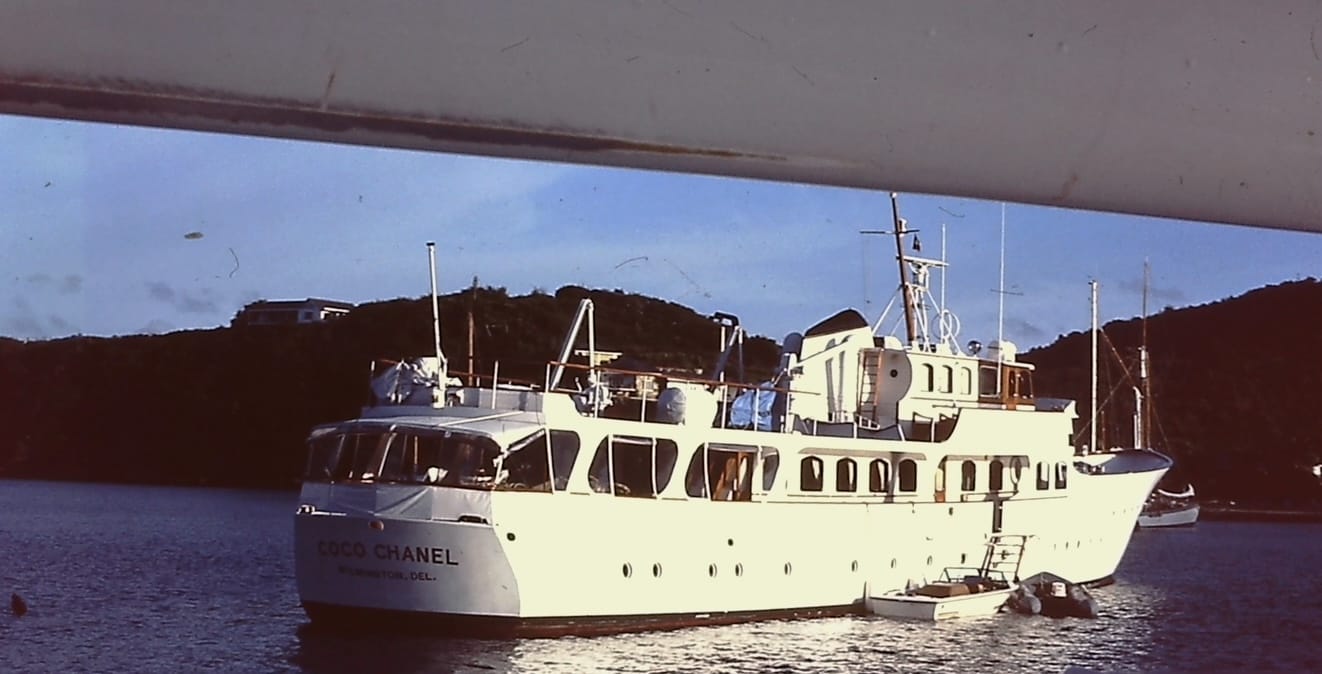
We spotted the island of Antigua in the morning mist. We sailed into English Harbour through the narrow, rocky entrance. Most sailing yachts use power through the opening, but we entered only under sail as the anchored boats were awakening. Seeing this lovely, large ketch quietly tacking through the fleet in the spacious anchorage was quite a sight. We passed right off the stern of a classic motor yacht named Coco Channel. A gentleman having his morning coffee nearly dropped his cup as Palawan passed only yards from his transom.
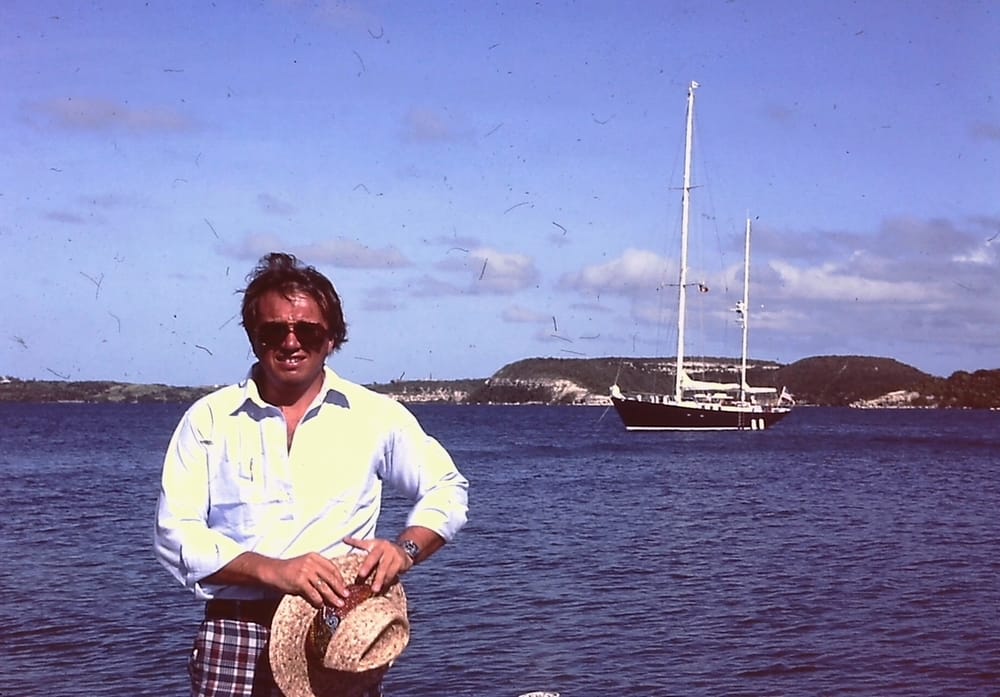
We regained our land legs, which was challenging after seven days at sea. Our crew explored the island, sampled local rum and food, and relaxed in the wonderful Caribbean weather. Watson’s home was in a converted sugar mill plantation, which we toured. I also did some diving off the reef to the entrance of English Harbour but hurt my ear drums by going too deep.
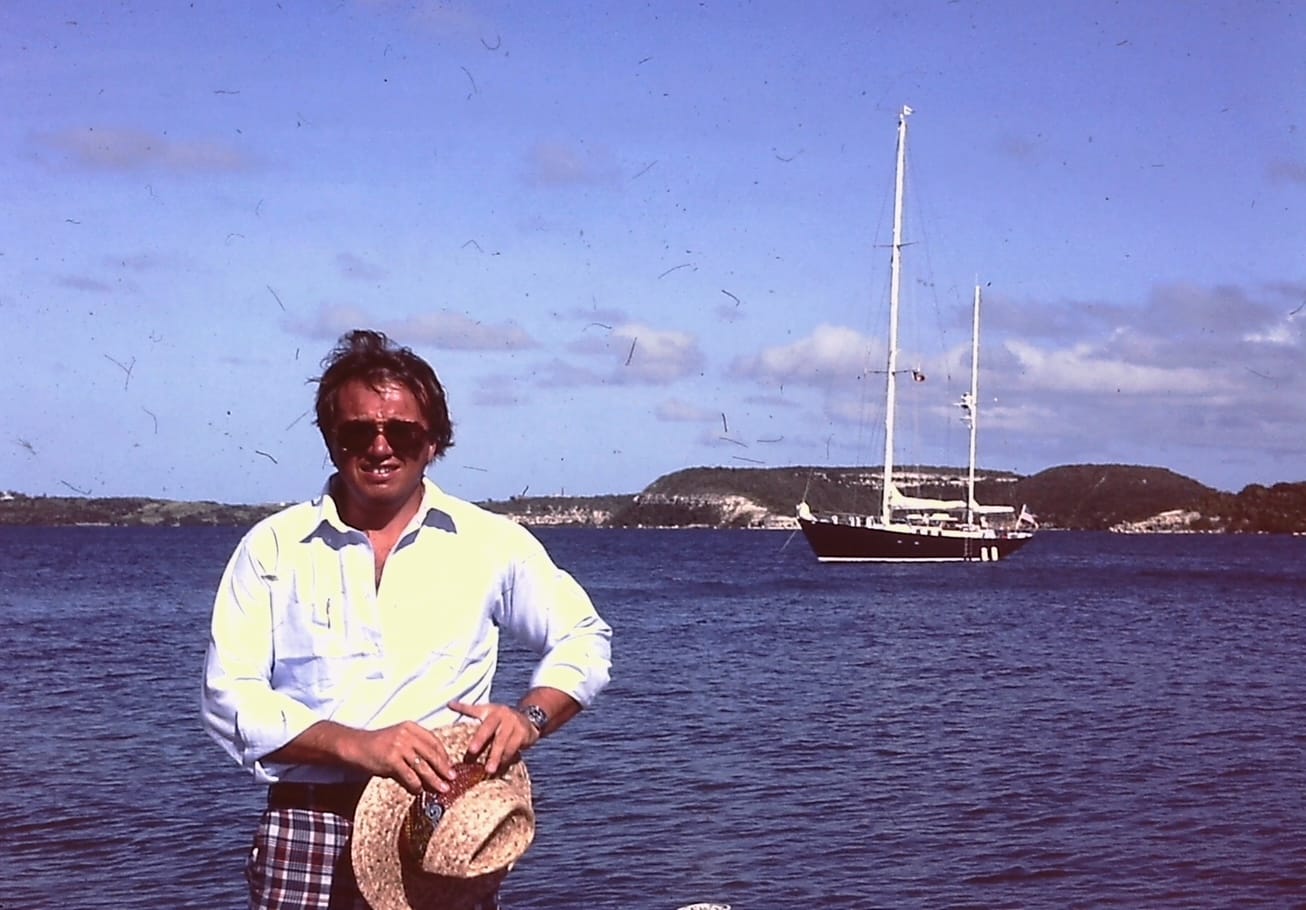
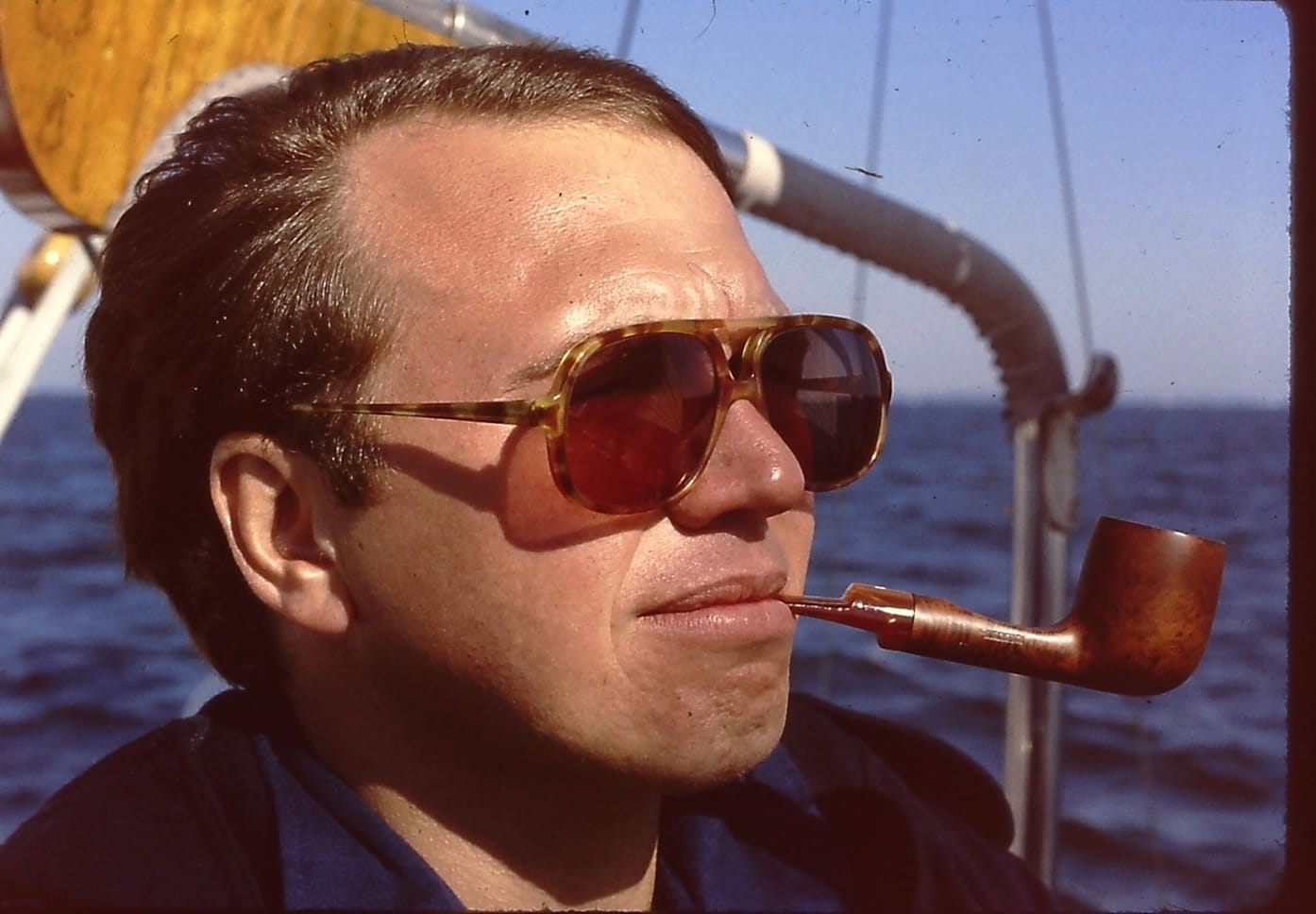
L: Rick Casali and Palawan in English Harbour on Antigua. R: Rick Casali at helm of 68 foot ketch Palawan. [Photos courtesy of the author]
Tom Watson eventually sold the aluminum Palawan and had a larger one built in fiberglass by Little Harbor Yachts in Taiwan. TV personality Jeraldo Rivera purchased the boat that we sailed and he cruised in her to many corners of the globe. He eventually donated her to a charity in Maine, as I recall. Some years later, a boater from upstate New York purchased the aluminum 68-footer, renamed her Adventurer and brought her to Alexandria Bay for Pirates’ Week. When Anne and I saw her, the flag-blue Awlgrip[1] on the hull was faded, and the varnish needed some attention, but the classic lines were very much intact. I wondered what the late Tom Watson would think to see his stunning yacht manned by crewmen dressed like pirates? However, Tom was a great sailor who loved rum and pretty islands, as well as fun afloat. I guess we’ll never know, but I believe that Tom would smile at seeing his yacht still being enjoyed.
- Awlgrip is a high-performance marine coating renowned for its durability, gloss retention, and superior finish. It is specially formulated for use on boats and yachts, providing excellent protection against harsh marine environments.
By Rick Casali
Rick Casali is a resident of Wellesley Island. During his youth, from 1947 to 1976, his parents had a cottage on Grindstone Island named The Orchards. Rick now splits his time between Stuart, FL, and the River. He worked for Columbia Gas System for 29 years and ran their Washington, DC office. Then in 2000, he started brokering boats and yachts, and he continues as a broker with North Point Yacht Sales. Rick and his wife Anne cruise the River in a recently purchased 1968 Chris Craft 31 Commander, which they named Foxtrot. They also have a Seaway 24 named Miss Annie.
Rick is a member of our Over 20 group of authors`. This editor is always in a good mood when his name appears in her email - another good one coming. This article is a fine example, right!
Comments
Andy Gustafson, Manzanita Island, Chippewa Bay writes: Very happy to read the article regarding the Palawan. I spent the summer of 1975 teaching age group sailing at the North Haven Casino on North Haven Island, ME. North Haven was the location of Tom Watson’s summer home and he kept the Palawan there in the summer months. I was drafted to assist the Palawan crew for day sails in Penobscot Bay when the Watsons had a large group of guests. Did not fall overboard, so was invited back numerous times to assist. She was an amazing vessel. Happy to report I was assigned to man the helm many times and did so without incident. The Palawan subsequently made a voyage to the Arctic which was well documented in National Geographic. Great memories of a great boat. Thanks.