Reprint: Site of the 1000 Islands Charity Casino (2001)
by: Blu Mackintosh
[Editor's Note: You know the expression... "there is gold in them thar hills?" Well for me the best kind of gold, is when I discover some new history about the Thousand Islands Region. This month I retrieved some binders filled with newsletters published by the Leeds and the 1000 Islands Historical Society.

It was easy to realize that much of what they have published in their newsletters is almost unknown to many of us on both sides of the border. We have permission to republish those articles that may have special meaning to Thousand Islanders. Luckily for everyone, the newsletters are all on their website, and can be downloaded free of charge. Mind you, if you do find some valuable history, consider joining the Society. Next month, we will provide an in-depth history of this special organization. You too, will be impressed, and if you are looking for gold, you will not have far to go.]
Site of the 1000 Islands Charity Casino
"HISTORICAL SOCIETY OF FRONT OF LEEDS AND LANSDOWNE FALL/WINTER 2001", Newsletter #16.
This summer, in August 2001, a fleet of red backhoes, drills, front-end loaders and dump trucks started swarming over the land on part of Lot 18, Concession I, in what is now Leeds and the Thousand Islands. (This new amalgamated municipality includes the former Township of Front of Leeds - which in turn included the previous Front of Leeds).
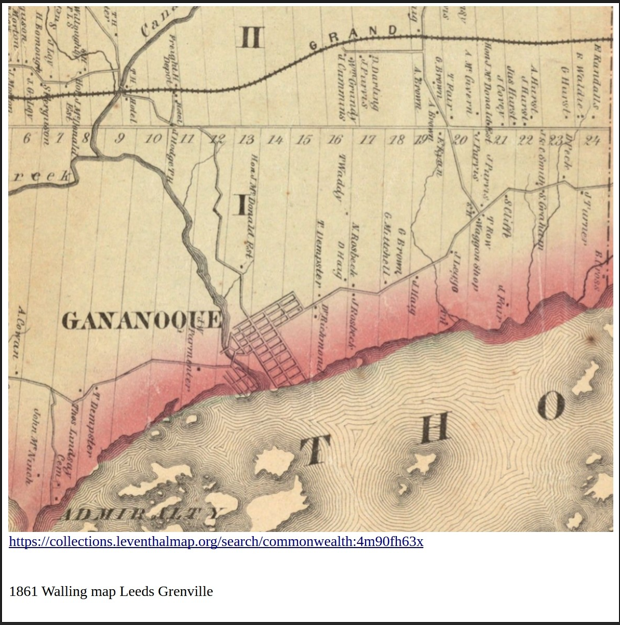
An Ontario government Charity Casino is being built, scheduled to open in 2002. This is just short of two hundred years since Letters Patent were issued in 1803 to one James Drummond for a parcel of 384 acres, which included this land. Its history is interesting. In May of 1846, the farm, stretching all the way from the St. Lawrence River to the northern boundary of the First Concession, was sold by Robert Russell Boag to George Brown.
The Browns had come to Canada in 1834, when George was 38. They were one of the many families who came to Canada from Berwickshire, on the east coast of lowland Scotland. Several families arrived from the same place at this time, and they must have been content to settle near one another and to see their children marry. The families’ names included Haig, Waldie, Mitchell, Lindsay, Brotherson and Richardson.
Judging from their photographs, George Brown and his wife, Janet McDougal, were no-nonsense, hard- working people. With their slightly grim mouths and determined eyebrows, they look like a couple who were not given to flights of fancy. They had a son who remained single, but their three daughters (who have the same square faces and firmly set mouths) married and settled close by.
Daughter Jane and her husband George Mitchell had the farm to the west (parts of Lots 17 and 18), Ann and her husband John Haig settled on the farm to the east (part of Lot 19), and Isabella and her husband David Darling were on the farm to the north on the second concession, as was George's brother Adam Brown.
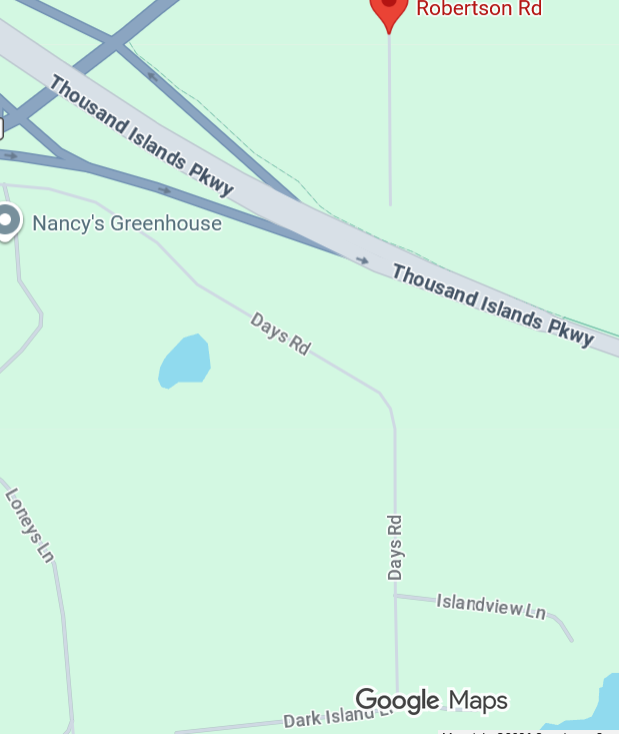
Between lots 18 and 19, there was originally a road allowance leading right down to the River. (Parts of it are still visible today in Robertson Road and the section of Day's Road that runs straight down to meet Dark Island Lane and Island View Lane.)
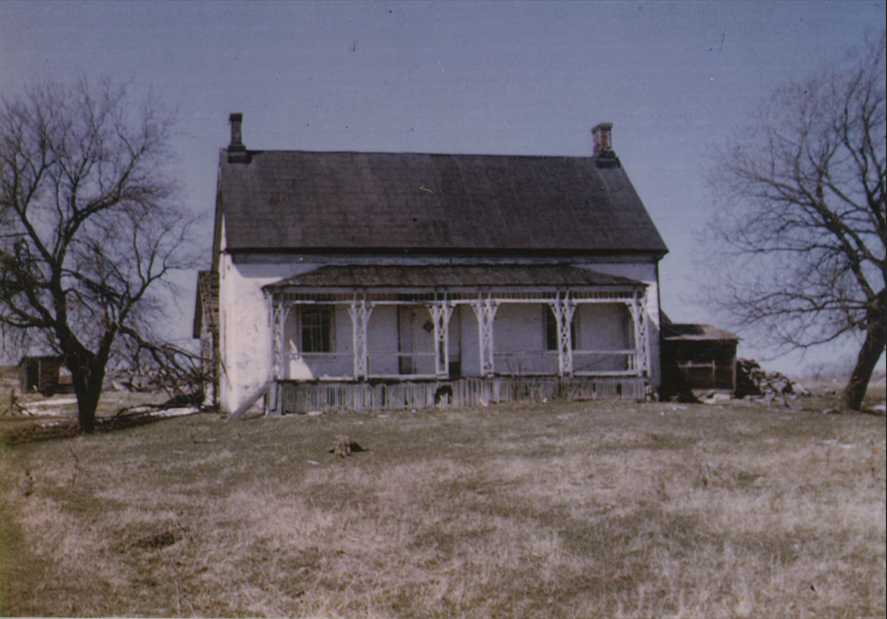
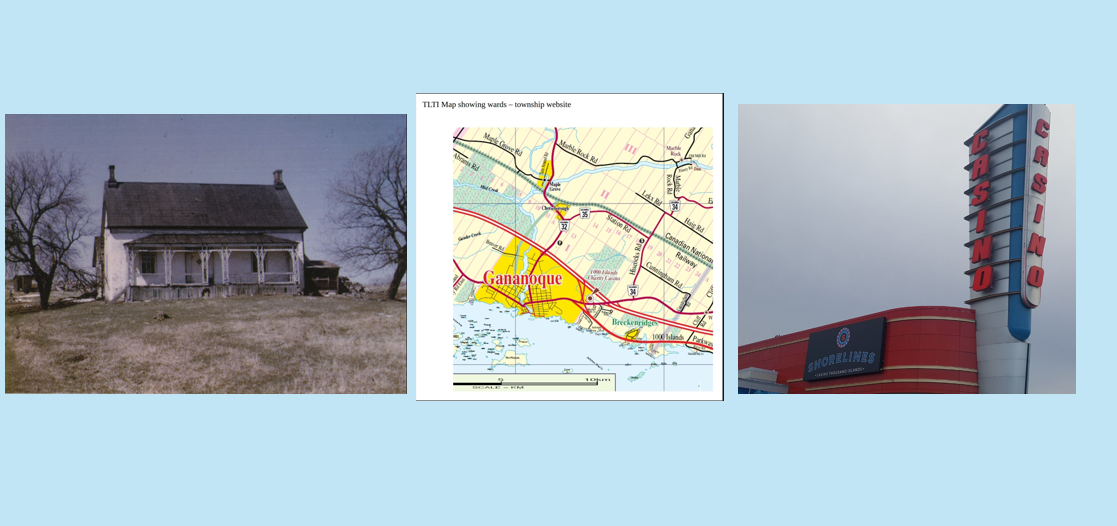
Although photographs of the family exist, we have found only one photograph of the house and none of the original farm buildings on this land, but before the bulldozers arrived this year, foundations of a house, a barn and several outbuildings were still discernible, located near a rocky outcropping not far from Highway 401.
However, Alan Lindsay, one of the many descendants of George Brown who still lives in the area, remembers it. "The house was stone, covered with rough-cast and painted white," he recalls. "Its style was unusual from other stone houses in the area because the roof had a steeper pitch. The chimneys, after they came through the roof, separated into two flues and then were joined into one again at the cap. A summer kitchen on the back was joined to the main house by a passage. There was an open verandah across the front. The house appeared to have little alteration. There was a large barn and also various outbuildings behind the house. "
Alan, along with Doug Gilbert of Ivy Lea and Arthur Waldie of Gananoque, are descendants of Isabella and David Darling. (Actually, they are also descendants of Isabella's sister Ann Haig, since Ann's daughter Janet married her first cousin, Isabella's son John McDougal Darling.) Peter Murray of Gananoque and Doug Matthew of Landon Bay are descendants of Jane and George Mitchell. who later founded Mitchell and Wilson.
In 1875, when George Brown reached the age of 79, he sold the eastern three-quarters of his lot to his nephew, Adam Brown. (The west quarter was already part of the farm of his daughter Jane and her husband George Mitchell.) However, Adam's wife died shortly afterwards, and he left the farm and moved to Michigan.
In 1882 , the farm was sold to Lawrence Gavin. George Brown had died in 1881 at the age of 85 and David Darling was the executor of his father-in-law's estate. Except for 40 acres at the north end of his property. which Lawrence Gavin sold to John M. Darling (who already had adjoining property in the second concession), the farm remained in the Gavin family for the next 56 years. Those who are alive today tend to remember the farm as "the Gavin place".
When he died in 1910, Lawrence Gavin left it to his wife, Ellen, until her death (which was in 1929), and after that to his son Lawrence Patrick Gavin. Art Waldie, a descendant of the Darling family, spent his childhood on the Darling farm abutting the Gavin farm to the north, south of where Hiscocks School is now.
His father had died when Art was a tiny baby, and his widowed mother and his brother moved in with George and Janet (McDougal,) Brown, owners of Lot 18, Concession 1 in 1846 with his grandfather, John Darling. He remembers in the 1920s, when he was about 12, walking with his grandfather down a path through pastures to visit the Gavin family. (There were, in fact, two Darling farms: his grandfather's and his uncle's, and at one point they swapped .)
It may have been during this period that the farm was rented out to Orange Running and his family. Lawrence Patrick Gavin's sister, May Loretta Gavin, known as "Mamie", eventually married Wilfred James 0' Brien . (They had two daughters and two sons. Art Waldie remembers taking out one of the daughters, Eleanor, who later married Brome Folkes.) When her brother died in 1936 at the age of 47, Mamie settled his estate. The farm was sold two years later.
The Halls' son, Bill, and his wife, Olive, settled on the farm, but it would only be for a few years. Tragically, Bill drowned on a fishing trip with Ford Gray on May 10, 1944, and the widowed Olive and her daughters, Virginia and Jeanne, moved away. Alan Lindsay recalls stopping in to say goodbye to Olive and the girls the day they left. Olive later remarried to Bert Nightengale. Her daughter, Virginia, later married John Lee, whose family still owns property on Hay Island.
A few years later, in 1948, the farm changed hands once again when John Welsey Hall sold it to a Polish man named Konstanty Mikulski. This would be the last time it would be owned as a farm. Mr. Mikulski appears to have owned it, at least at first, in conjunction with several other of his countrymen. Times were rapidly changing. The two world wars were over. Tourism was starting to grow.
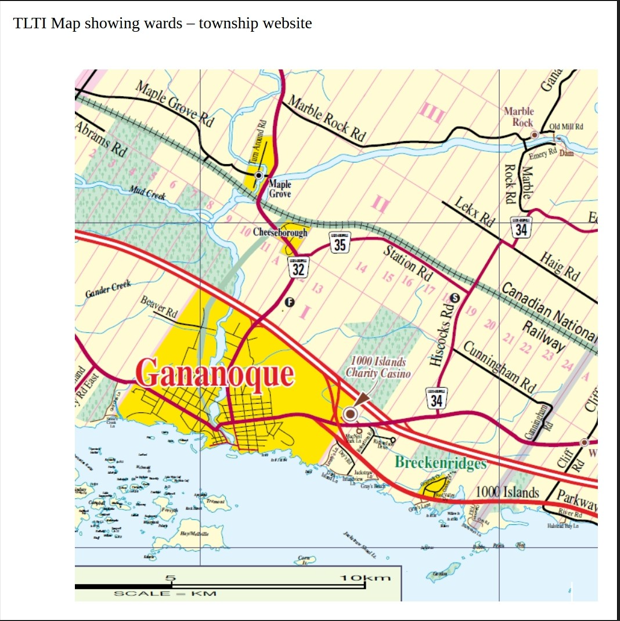
Residential and cottage property in the Thousand Islands was becoming sought after. The original Brown holdings, which had once stretched from the waterfront to the boundary of the second concession, had been divided many times over the years. Every family now had a car, and they needed more and better roads to drive on. The Thousand Islands Parkway (originally 2S for "Highway 2 Scenic") was built in the late 1930s. In 1955, part of the Mikulski farm was expropriated for the long ramp that joined the 401 to the Parkway.
The present-day Parkway overpass over Highway 2 goes right over where George and Jane Mitchell's house once stood. Their barn had been in the corner where the ramp from Highway 2 runs up to the west- bound 401. Alan Lindsay, who walked over the land many times as a child, remembers it well. "There was a spring there that ran out of a pipe in the corner of the barn all year round," he recalls. "That is why it is so swampy there still."
Meanwhile, Highway 401 was being built across the province. One of the last sections to be constructed was between Gananoque and Brockville, and in 1964, Mr. Mikulski sold the land to the Province of Ontario, which required it "for Provincial purposes". The 401 opened in late 1967, its double lanes and interchanges cutting a wide swath through what was originally George Brown's farm.
The final change came in 2000, the Ontario Lottery and Gaming Corporation (OLGC) announced its intention of constructing a "charity" casino in the 1000 Islands area. In November, a referendum question was on the municipal election ballot in Leeds and the Thousand Islands, Gananoque, Prescott and Brockville (the four municipalities pinpointed by the OLGC as desirable locations), asking citizens if they would be in favour of a casino.
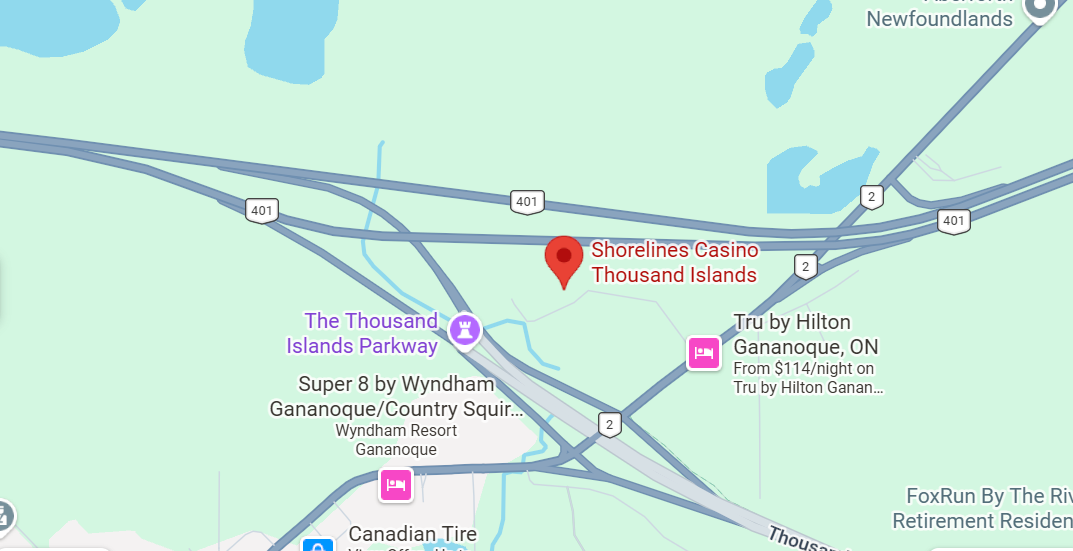
All four voted Yes, and the OLGC eventually chose this site, within the Township of Leeds and the Thousand Islands, but on the outskirts of Gananoque, within an easy drive of Kingston, and also close to the 1000 Islands Bridge to attract American gamblers. The site appears to be made up mainly of a section of George Brown's farm on Lot 18, but there is also a triangle on the west from George Mitchell's farm (part of Lot 17), and another on the east side in Lot 19, which had originally belonged to John Haig.
The location is highly visible to both Highways 401 and 2, a desirable feature for a casino wishing to attract passers-by. The parcel is a triangle bordered by Highway 40 I, Highway 2 and the long ramp between Exit 647 from eastbound 401 and the Thousand Islands Parkway. The architect's design, unveiled in August of 2001, shows a 1950s-style building with Art Deco touches and a high tower.
It would be hard to imagine a building and use with greater contrast to George Brown's original stone farmhouse, which has so many connections to local families.
Sequence of Ownership Site of 1000 Islands Charity Casino
Southern part of Lot 18, Concession 1, Twp Front of Leeds
1803 - Letters Patent to James Drummond
(1803 - 1846 - unclear)
1846 - R. R. Boag sells to George Brown
1875 - Adam Brown
1882 - Lawrence Gavin
1910 - Ellen Gavin (1ife estate)
1929 - Lawrence Patrick Gavin
1938 - John Wesley Hall
1948 - Konstanty Mikulski
1964 - Province of Ontario (for 401)
[NOTE: The casino, now called Shorelines Casino, continues to make significant money contributions to both the Township of Leeds and the Thousand Islands and to the town of Gananoque.]
By Blu Mackintosh
Blu Mackintosh (Anne) was born and brought up in Montreal. In 1962, she and her Scottish husband Douglas came to the Ivy Lea area and there they raised their three sons who often come back to visit with their families. A founding member of the Thousand Islands Area Residents Association (TIARA now Thousand Islands Alliance of River Advocates), Blu provided the first compilation of Canadian Islands Names, in a series of maps produced in the 1980s. She continues to be interested in the environment and the arts in general, and TIARA, Leeds and 1000 Historical Society, and the Thousand Islands Playhouse.