Memories of my father and the "Eastcliffe Hall"
by: Bill Byers
The Summer of 1970
A couple of years ago, while flipping through a long-neglected shoe box containing notes and letters of my mother’s, I found a small notebook belonging to my father. It took me back to the summer of 1970.
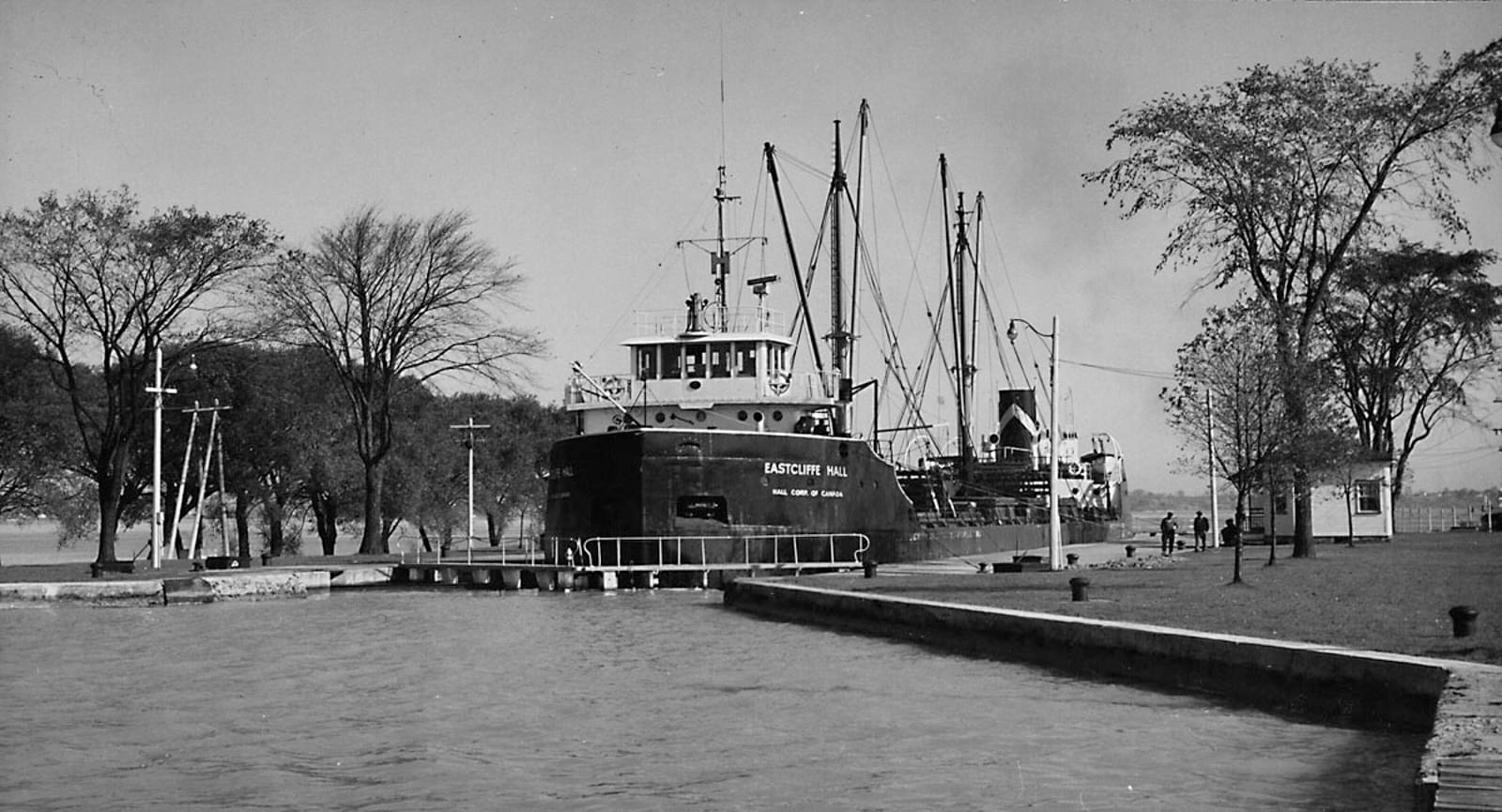
On Tuesday, July 14, 1970, at approximately 3:00 am, the 360-foot-long Eastcliffe Hall was sailing west on the Saint Lawrence River when she ran aground on the Gooseneck Island Shoal east of Morrisburg, ON. The captain managed to free the ship from the shoal, but in an attempt to return to the navigation channel, struck a submerged concrete crib that had supported an abandoned channel marker near the Crysler Shoal.
The impact with the abutment ripped a hole in the ship’s starboard bow below the water line. The ship sank to the bottom in less than three minutes. The black and white Hall Corporation freighter had departed from the port of Sorel, QC, laden with 6,000 tons of pig iron in its cargo hold, destined for Saginaw, MI. There were twenty-one people on board.
My Memories Begin
At 6:00 am on that same morning, I was sleeping at our cottage on Ault Island, near Ingleside, ON, when the ringing of the kitchen phone woke me up. The night before, I had worked a late shift at the 1867 Restaurant on the 401 highway, cooking hot dogs and French fries at the take-out window. My first thought was that I was being called in to cover someone for the morning shift. I wasn’t eager to go back to work, but I could use the extra cash. I was saving up to attend the Rock Acres Peace Festival in Madoc, ON, that August. (April Wine, The Stampeders, Edward Bear, Major Hoople, and Copper Penny were just a few of the headliners who were slated to appear.)
My mother went downstairs and answered the insistent phone; she was not long on the call before asking me to come quickly. I knew by her tone that it was an urgent request, not a hot-dog-French-fry emergency, but something greater than that. I recall her telling me that it was my father on the phone and that he had informed her that a ship had sunk early in the morning and that he was on the scene at the Crysler Park Marina.
He said there was a need for boats to get out to the site of the sunken ship and suggested I head up to see if I could be of assistance. At that point, I would have slipped on my cut-off denim jeans and the previous night’s t-shirt, which likely still reeked of fryer grease and headed out the door to launch the boat.
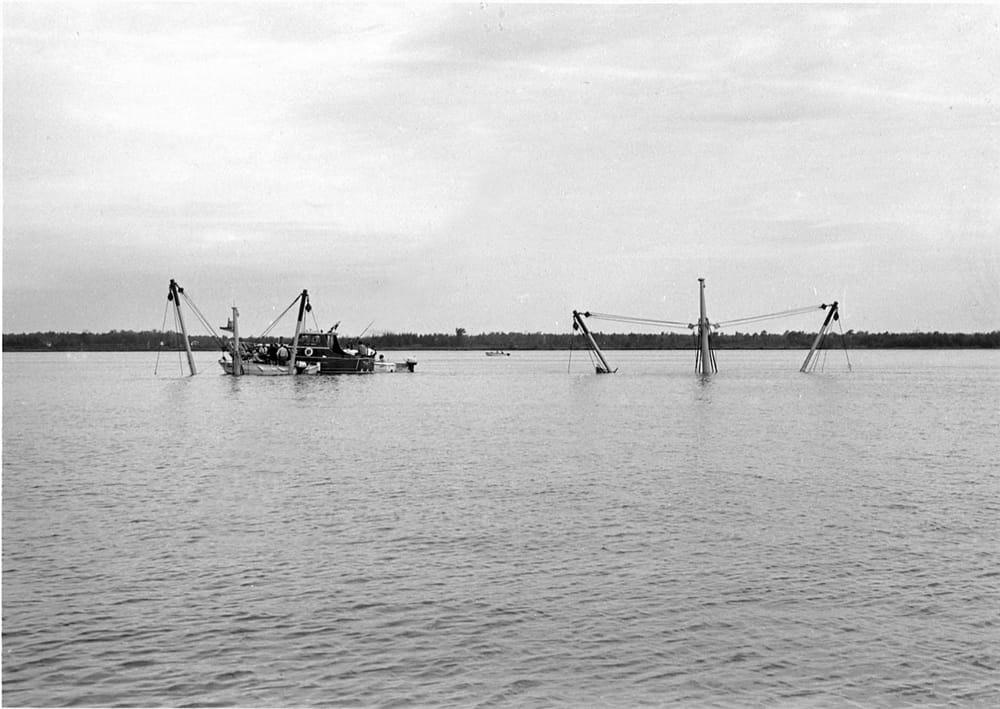
I cast off in our fourteen-foot fibreglass boat and pushed the fifty-horsepower Mercury to full throttle. It was a calm, cloudless morning. Not the type of weather to sink a ship. Crysler Park Marina was about ten minutes from our cottage at my top speed of thirty miles per hour. As I neared the marina, I spotted the wooden RCMP Patrol Boat, the Cutknife II, and a cluster of smaller boats lashed to the top of the sunken ship’s masts, which were protruding like the prongs of a trident above the water line. I wasn’t sure if I should head over to offer assistance, but first, I needed to get gas for the boat. I was running on fumes.
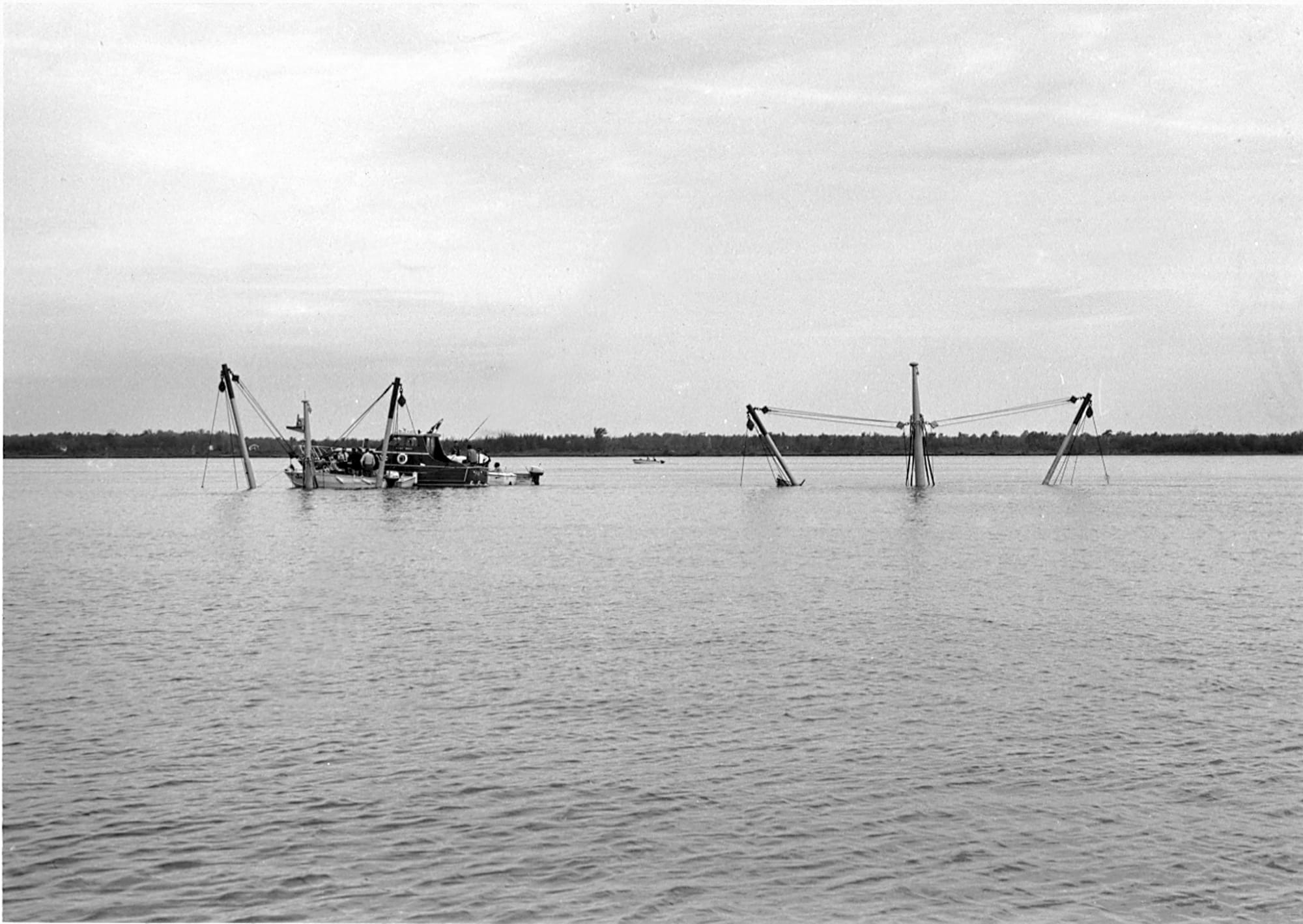
The sunken Eastcliffe Hall. [Photo credit: Marcel Queneville collection housed at the Cornwall Community Museum. (Marcel Queneville was a photographer with the Cornwall Standard Freeholder photographer and this photo may have been taken from my boat)].
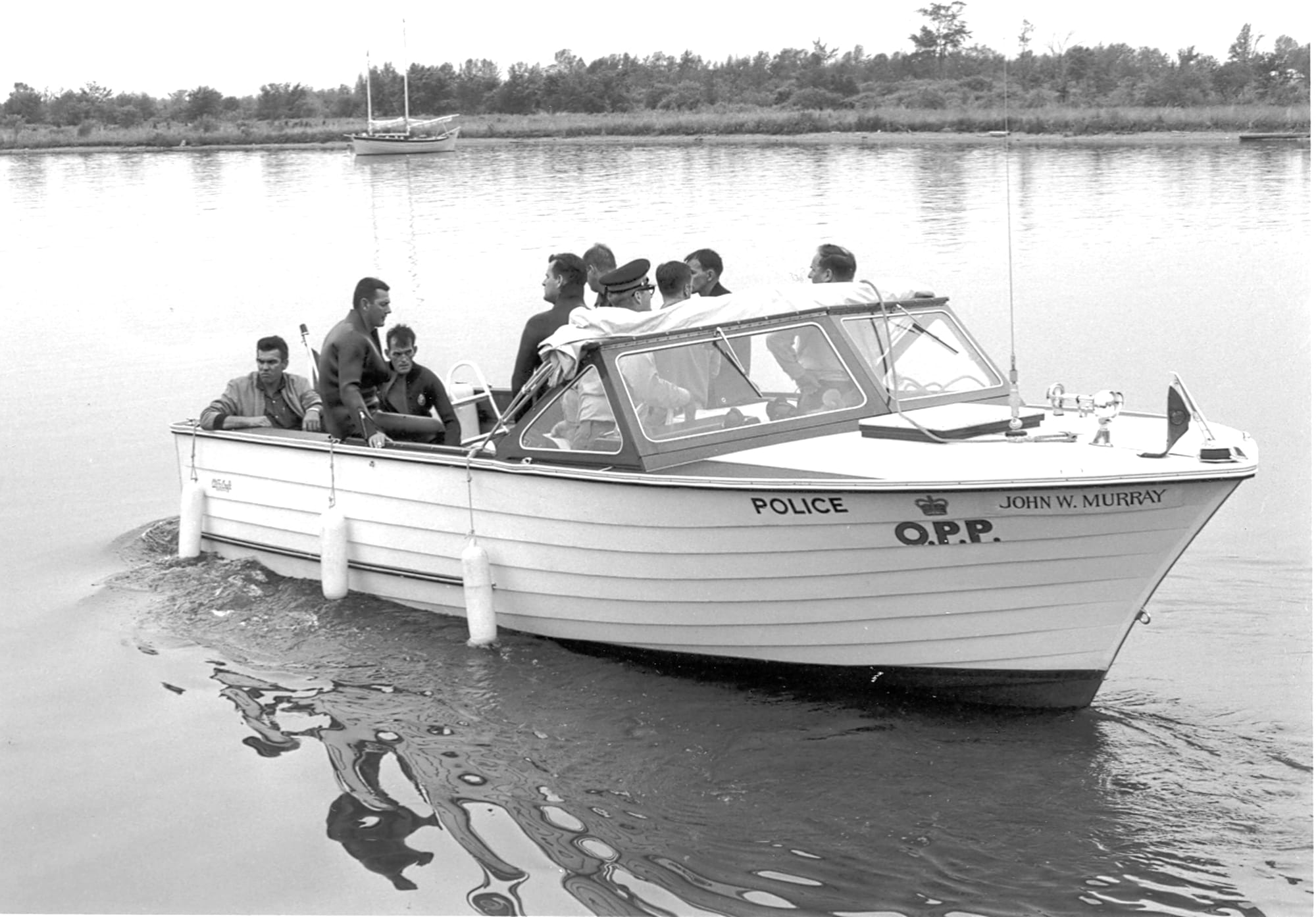
I headed into the marina to refuel. There was a congregation of OPP cars and vans in the parking lot. The OPP rescue boat, the John W. Murray, was at the gas dock. The marina gas jockey was a buddy of mine. He looked frantic and dishevelled, and normally wouldn’t be at work until 10:00 am. He told me to fill up my own tank and pay later as he jogged off towards the office. I asked a police officer if they needed the use of my boat. He said no and that it was best to keep away from the sunken vessel. At that point, I wasn’t certain how I was to be of any help.
A khaki coloured, circus-sized canvas tent had been erected at the south end of the marina parking lot. I knew there must have been casualties, as my father was on site in his role as the Dundas County Coroner. I assumed he was inside that tent.
I was topping off my five-gallon gas tank when a helicopter hovered overhead and landed on the grass next to the parking lot. A short, squat man in a checkered shirt and jeans got out with two cameras strapped around his neck and headed in my direction. He asked me if I could take him out to where the ship had sunk. I told him I could do that, and he stepped into my boat.
The OPP officer overheard our conversation and reminded me to keep a good distance from the site as there were divers in the water. On the way out to the site of the shipwreck, I would learn that the man I was transporting was a reporter for the now-defunct Montreal Star.
I circled the site for 15 minutes, keeping my distance as advised. The journalist got his photos and I returned to the marina where his helicopter awaited. As he stepped out of my boat and onto the dock, he turned and asked how much he owed me. I hadn’t even thought about getting paid. I shyly suggested that he could pay the marina the $4.00 that I owed for gas. He handed me a twenty-dollar bill and told me to keep the change before he headed off to talk to a police officer. While idling there in disbelief of my good fortune, a film cameraman and reporter from CJOH in Ottawa arrived at the dock and asked me how much it would cost to take them out to see the site of the shipwreck. I told them without hesitation that the price was twenty dollars.
That day, I ran a variety of news photographers and film camera crews. My last trip of the day was a salvage team that sent a scuba diver over the side of my little boat. I made two hundred dollars that day, which, according to a quick internet search, would equal about sixteen hundred dollars in 2025. Not bad for a day’s work for a sixteen-year-old, but not enough to give up my short-order cook job.
I would learn from watching the evening news later that week that nine people had drowned. The list included the captain, his sixteen-year-old son, the engineer, his wife, their six-year-old daughter, and four other crew members.
The Memories Grow
In the month of July, my father would spend his weekdays at our home in Winchester, where his medical office and the local hospital were located. He would come to our cottage for the weekends. I never did see my father on the day the Eastcliffe Hall sank. I don’t know what he dealt with inside the hospital tent, but the tragic loss of lives was familiar to him. He graduated from Queen’s University medical school in June of 1942, and enlisted straight away with the Canadian Army, before completing his internship. He became a front-line medic with the 1st Canadian Field Ambulance in Italy for 36 months. He received a Military Cross for bravery, a fact I would learn from a World War II veteran years later at my father’s funeral. My dad never talked to me about his military service or what he encountered in his roles as county coroner and a family physician, so I wasn’t expecting that he was going to disclose any insights into the cause of Eastcliffe Hall’s sinking.
The notebook of my father’s that I had recovered contained a page entitled “Eastcliffe Hall.” His handwriting was illegible to most, but as a child, I had learned to decipher his scrawl. He had noted that he had taken blood samples from the Eastcliffe Hall’s captain and sent them to a forensic lab in Toronto.
"New York Times", November 21, 1970
CORNWALL, Ont., November 20 (AP) — The sinking of the freighter Eastcliffe Hall in the St. Lawrence River on July 14, resulting in the death of nine persons, was attributed today to the captain’s “state of plain drunkenness” by Justice Francois Chevalier of the Superior Court of Quebec.
“That ship and all its contents, cargo and human beings were in the hands of a blind man who did not know where he was, nor what he was doing,” Justice Chevalier said.
Mr. Chevalier headed a federal Transport Ministry inquiry into the sinking. He summarized today his report of the hearings, which began on August 26. He said that a blood‐alcohol analysis showed that the ship’s captain, who died in the sinking, was intoxicated.
When I set out to write this piece, it was intended to be a tale of how I had made extra cash on the day the Eastcliffe Hall sank. However, in researching the shipwreck, it muddled up memories of my father and caused me to wonder once again, how he must have internalized tragedy.
While reading the front page of the July 1970 Winchester Press, which reported the ship’s sinking, I noticed that my father’s name appeared in a second story from that same week. He had attended the scene of an accident when a car had struck and killed a 6-year-old boy.
I can only guess about the burdens my father was carrying from his military service and his duties as a coroner, but I believe for a man that had seen his share of young lives cut short, the Eastcliffe Hall’s captain’s disregard for the safety of his crew and for his own sixteen-year-old son must have weighed heavily on him.
I obtained my driver’s license as soon as I turned sixteen in September of 1969, and my father began to ask me to drive him in the evenings as he made house calls to rural farms and, on occasion, to the scene of accidents. He was a solemn, stern man; he seldom spoke on those drives, other than to encourage me to drive faster while he lit up yet another cigarette from his ever-present red duMaurier package.
On occasion, he would nod off exhausted from a day of doctoring. I was never certain if I was invited to chauffeur him because he was too tired to drive, or was it that he simply enjoyed my company. Either way, I was happy to be next to him, driving the Plymouth on those gravel roads.
Now that I am in my 70s and looking back over the years, I wish that my father and I had talked more on those evening drives. But then again, I was a sixteen-year-old, determined to grow my hair long and hitchhike to a rock concert, so I probably wasn’t all that communicative either. Sadly, I didn’t know that our time together would be cut short. In 1972, two years after the summer of Eastcliffe Hall, my father developed early-onset dementia; our conversations faltered, and my questions remained unanswered.
By Bill Byers
Bill Byers was born in Winchester, Ontario and spent his childhood summers at the family cottage on the St. Lawrence River. He has resided in Montreal, Los Angeles, Boston, Ottawa and Toronto, and is now retired after a career in film production and education. Bill currently lives in Gananoque, Ontario with his wife Brenda.
His fascination with the flooding of the St. Lawrence Seaway and the impact it had on the residents led to the completion of his first novel “A Stone’s Throw” in 2024. The book was reviewed in our January 2025 issue, "A Stone's Throw" - a Book, History and What Will Happen Next?" [Editor's note: just thinking about the book makes me smile. One of those books you want to read twice.]
Comments
Al Gracewski, Livermore, CA, writes:
Susan Smith/Bill Byers: I enjoyed reading your article concerning your father and the Eastcliff Hall. Your writing is done so well, I felt I was in your shoes for your boat trips out to the Eastcliff Hall. It brought out several reactions in me:
How a great ship and a number of lives can be lost "at sea" due to human error brought on by alcohol. The scourge of drinking remains in our society with many lives lost due to automobile accidents (injuries to passengers in the cars and by pedestrians hit crossing the street)....not to mention the trauma caused by alcohol abuse in the home.
How jobs and war time experiences can affect people. I do think there are many people who hold such experiences inside and don't discuss their feelings, even with loved ones close to them.
How it is important to get as close as we can to our parents while they are living (and of clear mind) so we bear no regrets when they pass. Communication between generations can be difficult, but attempt it we must.
Thank you for sharing your recollections of an interesting event (the sinking and ferrying people out to the wreck site in your small outboard boat) and remembering your father and his service to humanity.